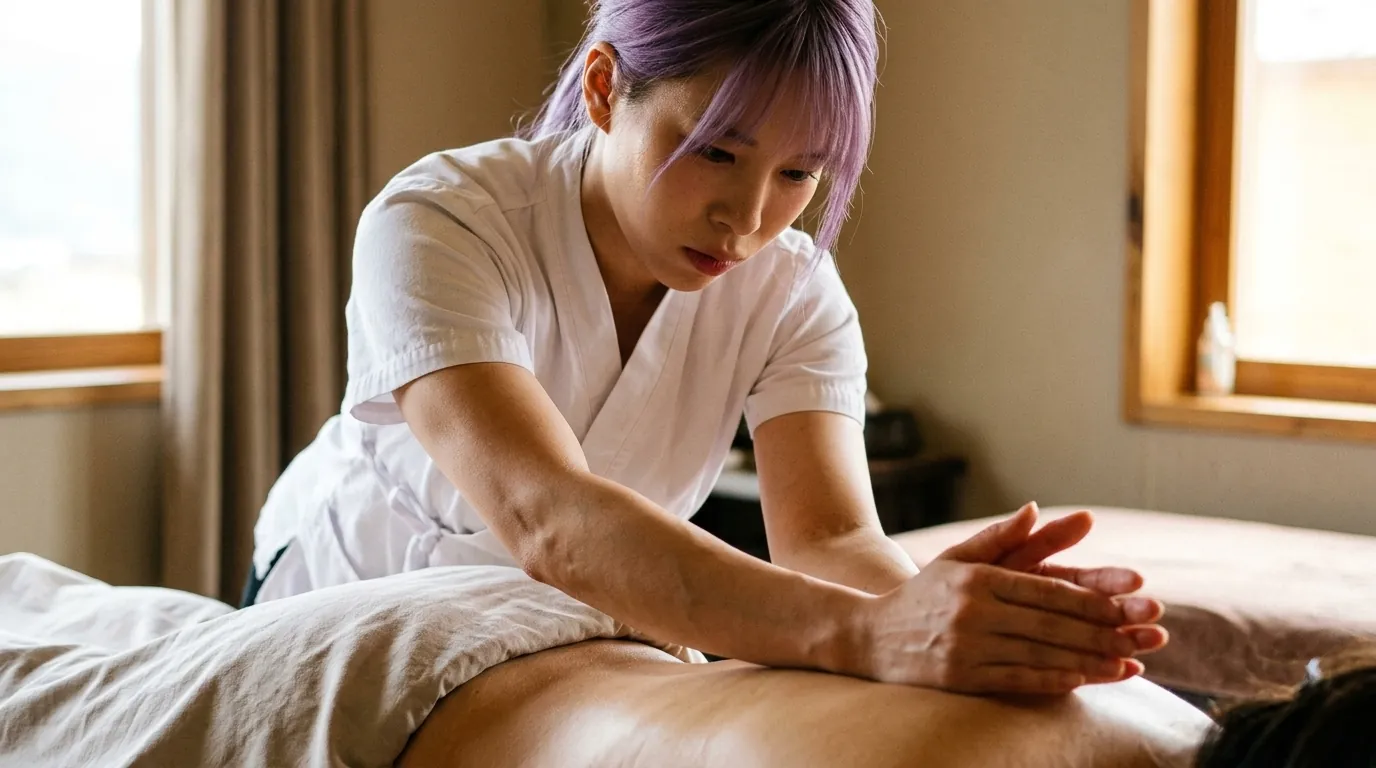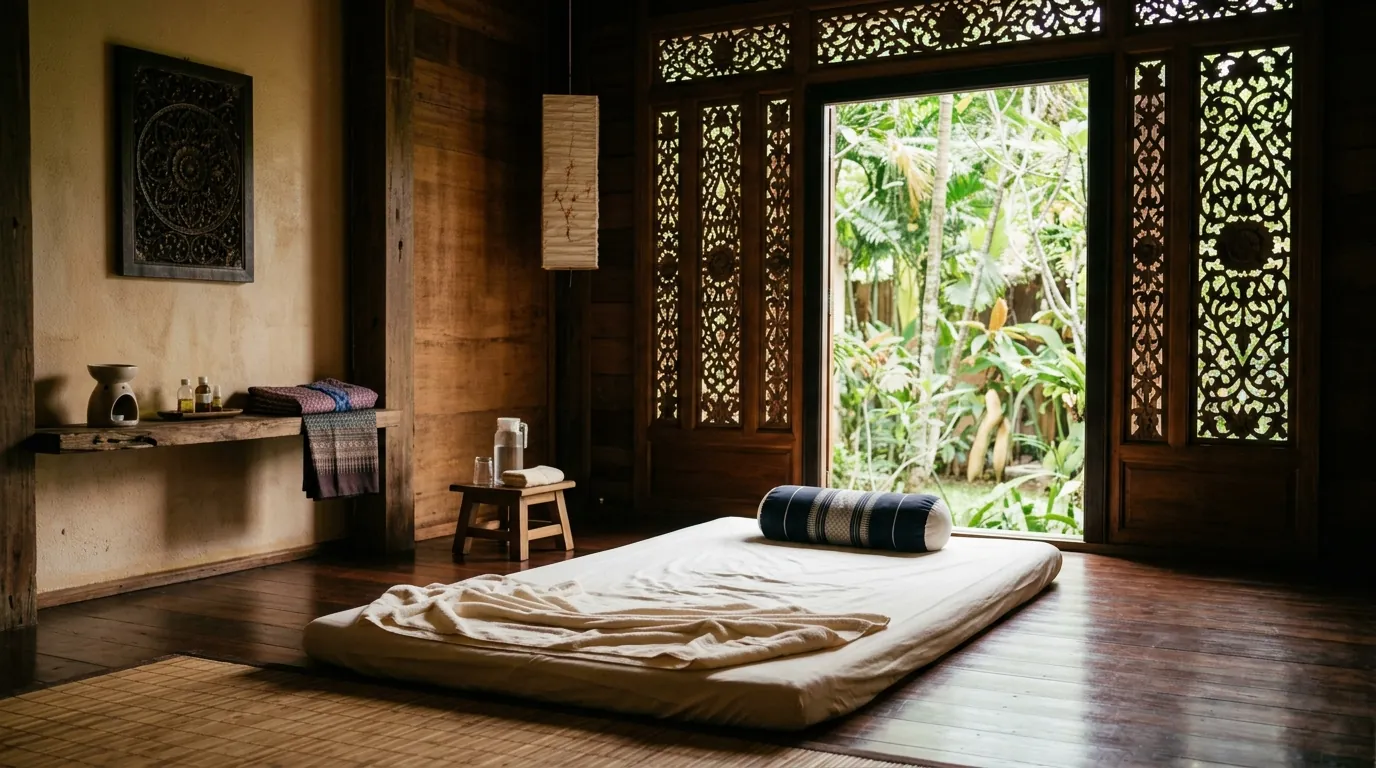
A Thai combination massage takes two different traditions and runs them in the same session. One is the Thai lineage: assisted stretching, pressure applied along lines that run the length of the body, attention given to arms and legs rather than only the back. The other is oil massage, closer to what most people picture when they hear the word massage. The interesting part is what happens where the two meet.
A Thai combination massage blends traditional Thai technique with oil massage in a single session. The Thai element brings assisted stretching and pressure applied with thumbs, palms and forearms along lines of the body. The oil element brings long gliding strokes over warmed skin. The hour alternates between being moved and being worked on.
What does the combination actually combine?
The two traditions are built on opposite ideas about what you do during a massage. In oil massage you stay still. You lie down, you are covered, and the practitioner works over you while you do nothing at all. In Thai work you are moved. Your arm is lifted, your leg is folded, your shoulder is rotated, and the practitioner uses leverage and body weight to do that for you.
That difference is why the two feel so unlike each other, and why blending them changes the shape of the hour. A single-technique massage has one rhythm that builds and settles. A combination session has two, and it moves between them. You will find yourself sinking into a long stroke, then being repositioned, then sinking again.
Neither half is a watered-down version of the other. The stretches are the same stretches; the oil work is the same oil work. What changes is how much of each fits into one session, which is the trade you are making when you choose a hybrid.
What does the Thai side of the session involve?
Three things, mostly, and they tend to arrive in this order.
Compression
Steady pressure applied straight down through a palm, a thumb or a forearm, held for a few seconds, then released and moved along. It is not a stroke. Nothing travels. Think of it as a series of firm, patient presses down the length of a leg or across the back of the shoulders.
Pressure along lines
Thai practice maps the body as a set of lines running head to foot, and the pressure work follows those lines rather than following individual muscles. It is a traditional framework rather than an anatomical one, and it is the reason the work often turns up somewhere you were not expecting, such as the inside of a forearm or the arch of a foot. Where that map came from is a longer story than this article can hold.
Assisted stretching
The part most people mean when they say Thai massage. Your limb is taken slowly through a range of movement while you stay completely relaxed. The distinction that matters: you are not stretching. You are being stretched. Your only job is to let the limb be heavy, which is much harder than it sounds and is the single thing most first-timers get wrong.
What does the oil side bring to it?
Glide, and everything that follows from glide. Without a medium, a hand can press but it cannot travel far; skin drags and the stroke stops. Oil lets a forearm run the whole length of a back in one unbroken movement, which is where the drowsy, continuous quality of a Swedish massage comes from. It also lets pressure sink gradually rather than arrive all at once, the slow entry that defines deep tissue work.
There is a practical reason the oil work usually comes first. A stretch offered ten minutes into a session tends to feel easier than the same stretch offered in the first two, once the area has been worked over and warmed. The oil half is doing preparatory work, not just filling time. If you are curious about what is actually in the bottle, the choice between oil, balm and dry technique has its own article.
How is the session paced from start to finish?
- The conversationA few minutes before anything begins. Where you hold tension, how firm you like pressure, what you would rather they left alone. With this treatment, mention any joint that does not move freely, because the stretching is the part that involves your joints.
- Oil work to settle and warmBroad, unhurried strokes over the back and legs. This is the section that puts most people under. It is also, quietly, the preparation for everything that comes next.
- Pressure and linesThe rhythm changes. Strokes give way to holds. The pace slows and becomes more deliberate as the practitioner works down the lines rather than across the muscles.
- The stretchesUsually the middle to late part of the session, once everything has warmed. You may be repositioned several times. Some stretches involve the practitioner using their own body as an anchor, which is normal and should still feel controlled.
- The returnBack to quieter oil work to close. Ending on movement would leave you alert; ending on long strokes gives you somewhere to land before you have to stand up and be a person again.
That arc is the reason session length changes the character of this treatment more than it does for a single-technique massage. A shorter booking means two halves compressed, so it is worth naming which half you care about. A longer one leaves room for both to breathe. It runs to more than one length, and the choice between them is a real one here.
How does it feel compared with a straightforward massage?
Less sleepy and more involved. A Swedish massage tends to end with you slightly disoriented and reluctant to move. A combination session ends with you feeling longer and more awake, closer to the way you feel after a good unhurried warm-up than after a nap. People often report noticing hips and shoulders for the rest of the day, in the sense of noticing they have them.
Against focused deep tissue work the difference is coverage: deep tissue narrows to one region worked slowly, while the combination spreads across the whole body and reaches joints that hands alone do not address. The direct comparison has its own article if that is the decision you are actually making.
Who tends to enjoy this treatment, and who might not?
It suits people who feel stiff rather than sore, which is a different complaint and often needs a different answer. It suits people who find lying still for an hour slightly boring, because here you are being moved every few minutes. And it suits people who stretch badly on their own, which is most of us; being taken into a position by someone else removes the temptation to cut it short.
It suits you less well if you want to switch off completely and not be asked to do anything, including being repositioned. It also suits you less well if one specific tight spot is the entire reason you are booking, because half the session will be spent elsewhere.
What should you tell the practitioner before you begin?
More than you would for an oil-only massage, because the stretching moves your joints and only you know how they behave. Mention anything that clicks, catches or has a history. Mention a knee that does not like being folded, a shoulder with a limit, a back that is fine until it is not.
- Which areas you want attention on, and which you would rather were left alone
- How the pressure is landing, while it is happening rather than afterwards; the pressure guide gives you the words for it
- Any position that feels wrong, even if you cannot explain why
- Whether you would prefer more stretching or more oil work
One thing to settle before you book this or anything else. A pregnancy, an injury, or a condition you are under care for is a question for your doctor, and nobody at a spa can tell you whether a treatment suits your circumstances. Come with what you have been told and it gets worked around. Saying what you want is a skill worth having, and it takes about thirty seconds to use.
The stretching and the oil are not two halves of an hour. They are two ways of asking the same body to stop holding on.
If the blend sounds like the right shape for the way your body has been feeling lately, it sits alongside four other treatments in the collection, each built around a different kind of hour.
Common questions
Do I keep my clothes on for a Thai combination massage?
It depends on how the session is arranged, because oil work needs skin and Thai stretching is traditionally done clothed. Most combination sessions handle this with draping, uncovering one area at a time for the oil work and covering you again for the stretches. Ask when you book if you would like to know exactly how it will run, and say so if anything about it would make you uncomfortable.
Do I need to be flexible?
No. The stretches are taken to the point where you feel a gentle lengthening and no further, and that point is different for everybody. A stiff body simply means smaller movements. Nothing in the session asks you to reach a particular position.
Is a Thai combination massage meant to be painful?
It should not be. A stretch may feel strong and a pressure point may feel distinctly sharp for a second or two, but both should stay in the range you would describe as satisfying rather than sore. Pain is a signal to speak, not something to breathe through. Practitioners would far rather adjust early than find out afterwards.
How is this different from traditional Thai massage?
Traditional Thai massage is usually done fully clothed on a floor mat, with no oil at all, and the whole session is built from pressure and movement. A combination session keeps the stretching and pressure work but adds oil massage, so part of the hour is spent on long gliding strokes that a clothed session cannot include.
Can I ask for more stretching and less oil work, or the other way round?
Yes, and it is worth saying at the start rather than halfway through. The balance between the two halves is the one thing in this treatment that is genuinely adjustable. Some guests come for the stretching and treat the oil work as the warm-up; others want the reverse.