Pressure is the one part of a massage you can change at any moment, and the one part most people never mention. You lie down, the work begins, you decide privately that it is slightly too light or slightly too strong, and then you stay quiet about it for the rest of the session. This is a guide to the words that fix that.
Massage pressure runs on a simple scale. Gentle is surface work you could fall asleep under. Medium presses into the muscle but never makes you brace. Firm is slow, sustained work that sits at the edge of comfortable. Pick a level at the start, then adjust it out loud during the session. Pressure is a setting, not a fixed part of the treatment.
What do gentle, medium and firm actually mean?
There is no dial on the table and no agreed measurement, so the three words only work if you and your practitioner mean roughly the same thing by them. Here is what each one tends to look like in practice.
Gentle
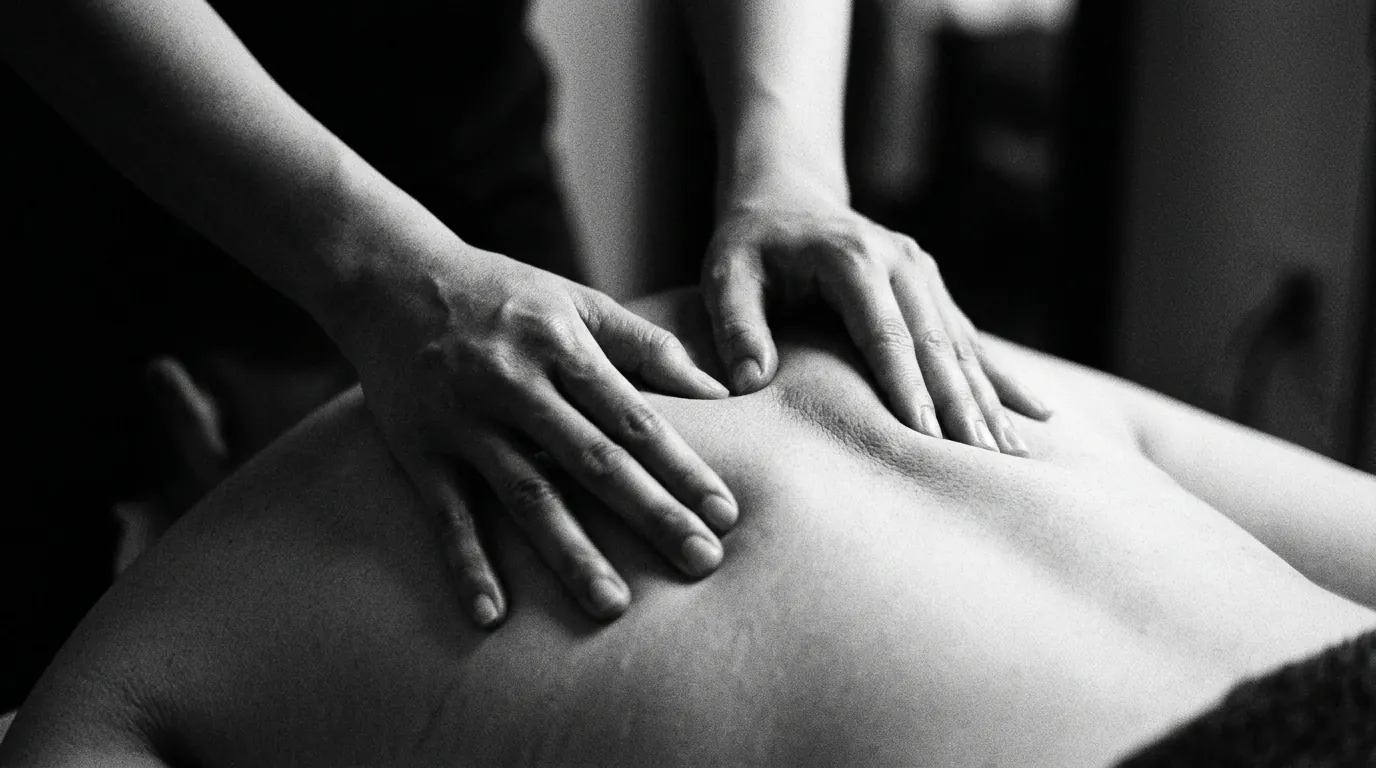
Gentle pressure stays close to the surface. Broad hands, long strokes, warmth and rhythm rather than depth. You notice the movement more than any single point of contact, and you can lose track of where the practitioner is working. It is not a lesser massage. Slow surface work is what most people mean when they say they want to switch off.
Medium
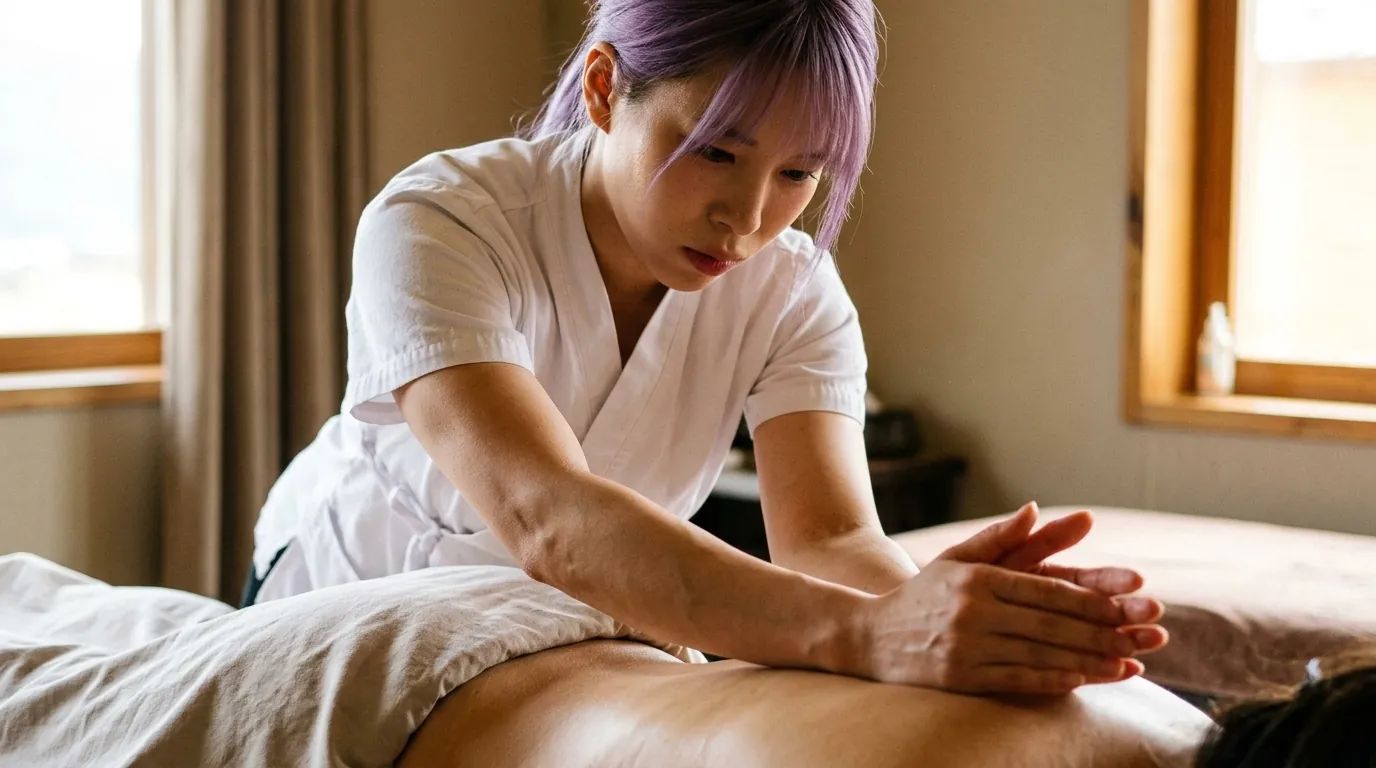
Medium presses through the surface and into the body of the muscle. You are aware of where the hands are. Tight spots register as something specific rather than as general contact, and you may find yourself exhaling when one of them is passed over. Nothing asks you to hold still against it. If you had to describe medium to someone, it is the level where you can feel the work clearly and still hold a normal conversation without your voice changing.
Firm
Firm is slower and narrower rather than simply stronger. A forearm or a thumb settles into one area and stays there while the pace drops right down. The feeling is usually described as an ache with something satisfying in it, sitting just on the comfortable side of too much. The honest test is your breath. If you can keep breathing out slowly, the pressure is in the right place. If you are holding your breath or pushing back into the table, it has gone past useful.
How do you choose a level before the massage starts?
You are being asked to name a preference for something you have not felt yet, which is why so many people answer with whatever sounds least demanding. It helps to treat the opening minutes as a calibration instead of a commitment.
- Start one notch lighter than you thinkPressure is far easier to add than to take back. A practitioner can build within a minute of you asking, but you cannot undo an area that has already been worked too hard, and you will spend the rest of the session guarding it.
- Give a map, not a single answerVery few bodies want the same pressure everywhere. Say something like firmer across the shoulders and upper back, lighter on the neck and legs. That one sentence is more useful than any single word you could pick.
- Make the first five minutes a testSay out loud that you will give feedback once the work begins. It turns your first comment from an interruption into something expected, which makes it much easier to actually say.
- Agree on your own shorthandLighter, firmer, slower, move on. Four words, settled before you are face down and half asleep, and you never have to compose a sentence mid-session.
What do you say to change the pressure mid-session?
The reason people stay quiet is rarely shyness. It is that they cannot think of a phrase that does not sound like a complaint. So borrow one. Any of these can be said quietly, face still in the cradle, without lifting your head.
- "A little lighter across my shoulders, please. Everything else feels right."
- "Could you go slower there rather than harder?"
- "That is close. One notch firmer when you go back over it."
- "Could you leave that spot and move on? It is a bit much today."
- "That is exactly it. Please stay at this for the rest."
The second one is worth keeping. Slower is not the same as harder, and slower is usually what people mean when they ask for more. If an area feels like it is being passed over too quickly, asking for weight will often just add force to the same speed. Asking for slower gives you the dwell time you were actually after, with less intensity on the way in. There is a whole conversation to be had about the rest of it, and saying what you want on the table covers the areas, the silence and the awkward parts beyond pressure alone.
Where do the five treatments sit on the scale?
Each treatment has a natural range it lives in, although you are adjusting within that range rather than being locked to it.
| Treatment | Usual range | What sets the level |
|---|---|---|
| Swedish | Gentle to medium | Long flowing strokes across the whole body, so the level stays fairly even from start to finish. |
| Deep Tissue | Firm and focused | Slow sustained work in a small number of areas, with the pace doing most of the work rather than force. |
| Thai Combination | Medium to firm | Pressure arrives in two forms: held acupressure points and the stretch of a supported movement. |
| Couple Massage | Set individually | Two guests, two practitioners, two separate conversations. You do not have to match each other. |
| 4 Hands | Coordinated and flowing | Two practitioners moving together, so the level is set once for the pair and generally stays even. |
A Swedish massage asked for a little firmer is an entirely normal request and does not need to become something else. The difference with Deep Tissue is the shape of the session rather than the strength of it, trading full-body coverage for concentrated attention in fewer places, and the comparison between the two goes into that properly. Thai Combination is the one that surprises people, because a good deal of its pressure comes from being moved and supported rather than from hands pressing down, which reads as firm without ever feeling forceful.
Why does too much pressure work against you?
Whether firm is better at all is settled in the Swedish and deep tissue comparison. What matters here is the mechanism, because it explains why the notch you think you want is often one too many.
When something is uncomfortable you tense against it without deciding to. Your shoulders lift, your breathing goes shallow, and the area stiffens under the hands, so the practitioner ends up working against resistance you have just added. The work slows down rather than going deeper. People who spend a session braced tend to describe it afterwards as wrung out rather than restful, which is why easing off by one notch usually gives the better session.
At your pace. Your comfort should guide the experience.
The Massage & Spa Club
How do you know the pressure is wrong for you?
Your body signals it before your mind decides anything. Most people can recognise at least one of these from a past session.
Too light has quieter signals. You cannot feel where the hands are, your attention keeps wandering back to your day, or you find yourself wanting to press up into the contact. If you notice that, ask for one notch firmer rather than waiting to see whether it changes on its own.
Does your level stay the same from visit to visit?
It moves around more than you would expect. A week of poor sleep, a hard training block, a long flight, the time of day, even how warm the room is when you arrive: all of it changes what feels right. The setting that suited you last month can feel like too much today.
So state your preference fresh every time rather than assuming last visit's note still applies. Two contexts shift it reliably, and they have their own pieces: massage around training and massage after a long journey.
Choosing with pressure in mind
If you are still deciding, the useful question is not how much you can take. It is how you want to feel when you sit up at the end. Wanting to be eased into the evening points one way on the scale, and wanting particular attention paid to a shoulder that has been complaining all week points another. Either answer is a good one, and either way you can change it once you are on the table. The treatment menu lists the usual pressure range alongside each one, which is a reasonable place to start.
Common questions
What is the difference between medium and firm pressure?
Medium presses through the surface into the body of the muscle and keeps moving at a steady pace. Firm slows right down and stays in one place longer, so you feel the work concentrated rather than spread out. The change between them is often more about speed and dwell time than about strength.
Is it rude to ask for less pressure halfway through?
No. A practitioner would far rather adjust at minute twenty than hear at the end that the last forty minutes were uncomfortable. Asking is treated as information, not criticism. Saying nothing is the only version that wastes the session.
Should a massage hurt to be worth it?
No. Sensation and pain are not the same thing, and there is nothing in a session that requires you to endure. A useful line is that you should be able to keep breathing out slowly. If you cannot, the pressure has gone past where it is doing you any good.
Can I have different pressure on different parts of my body?
Yes, and most people do. Shoulders and upper back often want more, while the neck, the backs of the legs and anywhere bony usually want less. Say so at the start and the practitioner will carry a different setting into each area.
What if I do not know what pressure I like?
Start at medium and treat the first few minutes as a test rather than a decision. Once the practitioner has worked across your shoulders, you will have something real to compare against. Say whether that felt right, light or strong, and go from there.