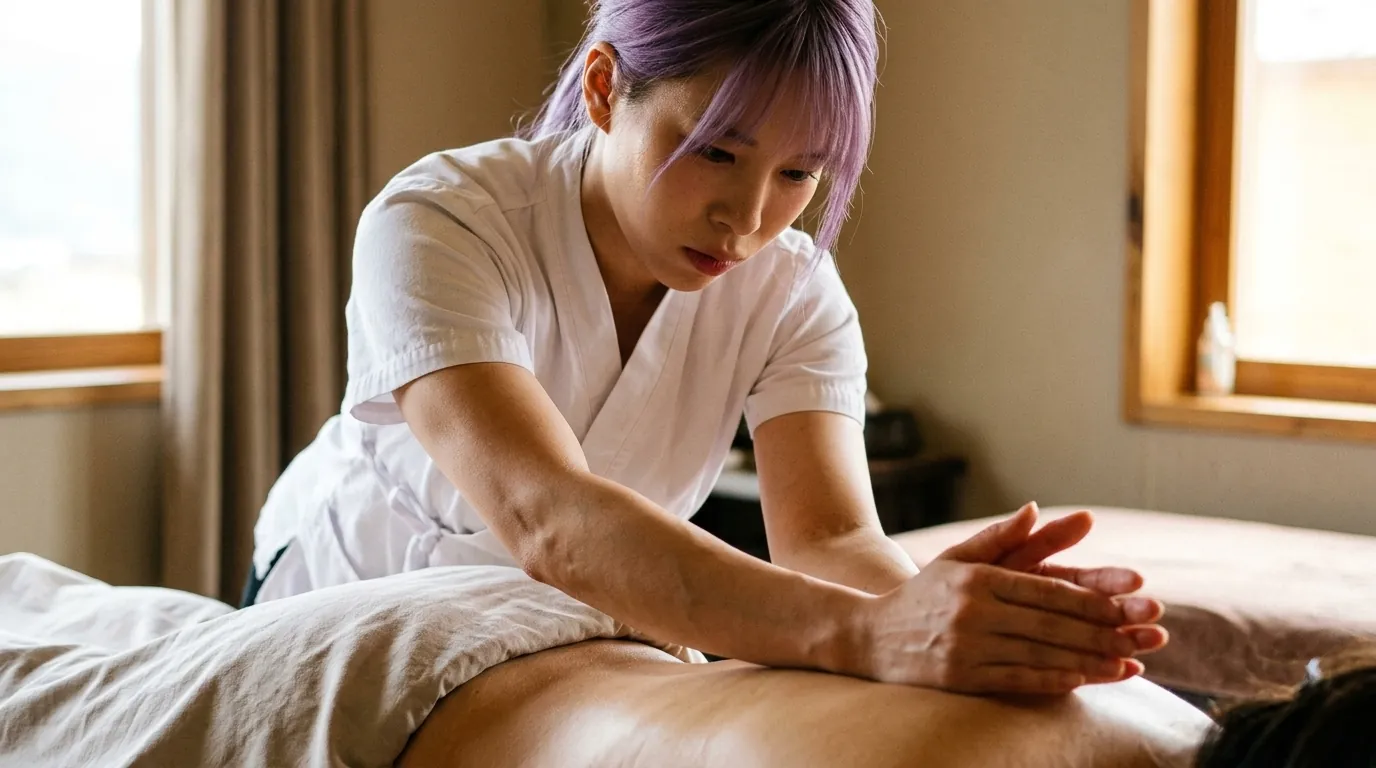
If you already train to a plan, a massage is not really a question of which treatment you fancy. It is a question of which day it goes on. A session leaves you feeling different for a while afterwards, and if that while happens to land on your hardest effort of the week, you have made a decision without meaning to.
Treat a massage as another item in the training week rather than an extra. Firm work usually sits best on a rest day or the evening after a hard session, with a clear day before your next big effort. Lighter work can sit closer to it. If the treatment is new to you, book it where the following day matters least.
Why the day matters more than the treatment
People come out of a firm session feeling all sorts of things. Loose and a little heavy is common. So is a mild tenderness in one or two places the next morning, in the way that a new exercise leaves you aware of a muscle you had forgotten about. Some people feel nothing at all beyond having enjoyed the hour. None of that is a problem on a Sunday. It is a nuisance on the morning of a session you have been building towards for a month.
So the scheduling question comes first. Pick the day, then pick the treatment that suits it, rather than booking your usual treatment and hoping the week bends around it.
Should you book a massage before or after a workout?
After is the simpler answer, and mostly for unglamorous reasons. You are finished for the day. Nothing is waiting. You are not watching the clock because a class starts in forty minutes, and you are not trying to talk yourself back into effort afterwards. An hour that ends the day tends to be a better hour.
Before training is not off limits, but it changes what you are walking into. You arrive at your first set or first mile feeling unfamiliar, and unfamiliar is fine on an easy day and unhelpful on a day where you want to know exactly what your body is doing. If you want to try it, try it before something routine. The worst version is the tight sandwich: a session squeezed between a morning effort and an evening one, where you spend the hour thinking about the next thing.
Where firm work belongs in the week
Firm work is the part of this that needs the most space around it. A deep tissue massage is slow, specific and worked into a small number of areas rather than spread across the whole body, and people commonly report being aware of those areas for a day afterwards. Give it a clear day before your next hard effort and it sits in the week without argument. Put it the night before a heavy session and you are guessing.
A Thai combination massage behaves differently in a plan because half of it is assisted stretching. You are moved through positions rather than lying still throughout, and the day after tends to feel more like the day after a mobility session than the day after firm pressure. That makes it a reasonable fit alongside a training week, though the same rule applies: not the night before the thing that matters. If you are unsure how firm to ask for in the first place, the guide to massage pressure covers that separately.
What about rest days?
A rest day is the obvious slot and it is usually the right one. The only thing worth checking is what sits on the other side of it. A rest day that falls immediately before your longest session of the week is not really a free day, because whatever you feel tomorrow you will feel during that session. A mid-week rest day with an easy day after it is the better slot, even if it is less convenient.
If you train most days and there is no true rest day to work with, use hard and easy instead. The evening after your hardest day, with an easy day following, does the same job.
| Slot in the week | What tends to suit it | Why |
|---|---|---|
| Evening after your hardest session | Firm or medium work | The day is already spent and the next day is usually easy |
| A rest day with an easy day after it | Deep tissue, or a long session | Two quiet days either side leave room for anything |
| A rest day before your longest session | Lighter oil work, if anything | The day after is not actually free |
| Two or three days before an event | Something light and familiar | Not the week to meet a new sensation |
| Straight before training | Only a treatment you have had before | You want to know what you are walking into |
Does session length change where it fits?
It changes the slot more than you would expect. A shorter session usually means one region gets attention and the rest is left alone, which makes it easy to place on a weekday evening. A longer one covers more ground and asks more of the day around it, so it wants a slot where you are not going anywhere afterwards. Stretch-based work in particular is worth the longer booking, because the assisted positions take time to get into properly. The difference between a sixty and a ninety minute session is worth reading before you choose.
How to put it into a training block
- Find the fixed points firstWrite down the two or three sessions in the week you would not move. Everything else is negotiable and the massage goes in the gaps between them.
- Choose the day, then the treatmentA quiet day with an easy day after it can take firm work. A crowded week takes something lighter. Let the calendar pick.
- Keep the same slot for the whole blockA repeated slot tells you far more than a perfect one-off, because you start to know what Thursday feels like after a Wednesday session.
- Note the day after, onceOne line is enough. Whether the next session felt normal is the only information you actually need, and after three blocks you will stop guessing.
That last step is the whole method, really. Most of the advice floating around about massage and training is written for a body that is not yours. Two or three blocks of your own notes settle the question better than any of it. If you are still working out the underlying rhythm, how often to book is a separate question from where in the week it goes.
When to leave the week alone
Some weeks the answer is simply not this one. If you are unwell, if something has gone wrong in a way that is new and sharp rather than familiar and achy, or if you are carrying an injury or you are pregnant, speak to your doctor first. A practitioner gives a treatment, not a diagnosis, and a massage is not the place to find out what is actually going on. The appointment will keep.
Otherwise the reasoning stays refreshingly ordinary. A massage is an hour that has to fit somewhere, like everything else in a training week. Find the day where nothing depends on the morning after, put it there, and leave it there. When you know which day you want, have a look at the treatment menu and pick the one that suits it.
A light Swedish massage is the usual choice for the weeks where nothing can be risked, and firmer work waits for a quieter stretch of the calendar. Neither is the better treatment. They just belong on different days.
Common questions
Is it better to have a massage before or after a workout?
After is the easier default, mostly for practical reasons. You are already finished for the day, you are not trying to get back into a session afterwards, and nothing about the hour has to be rushed. Booking before training works, but it puts you into a set or a run feeling slightly unfamiliar, which is worth trying on an easy day first rather than a hard one.
Can I have a massage on a rest day?
Yes, and it is the slot most people end up using. If your only free day is the one before your longest session, the fix is usually the treatment rather than the day: ask for lighter, broader work and save the firm session for a deload week, when the days either side are quiet anyway. Moving the training to protect a massage is the wrong way round.
How long before a race or event should I stop booking firm work?
Most people who train regularly leave firm work outside the final few days and keep anything close to the event light and familiar. The reasoning is simple rather than physiological: you do not want an unfamiliar sensation in your legs on a day you have been building towards. Whatever you choose, event week is not the week to try a new treatment.
I train six days a week. Where does a session even go?
On the evening after your hardest day, usually. If every day carries a session, the useful distinction is not training versus rest but hard versus easy, so put the massage after the hardest one and let the easy day that follows absorb it. Booking the same slot every week is worth more than finding the theoretically perfect gap.
Should I tell the practitioner that I train?
Yes, and say it at the start rather than once the hour is under way. The useful details are what you have coming up in the next couple of days and which areas you would rather were left quiet, because both are easier to name while you are still sitting up and talking. If something has felt sharp or new since your last session, mention that too, and see your doctor about anything that is not simply ordinary soreness.