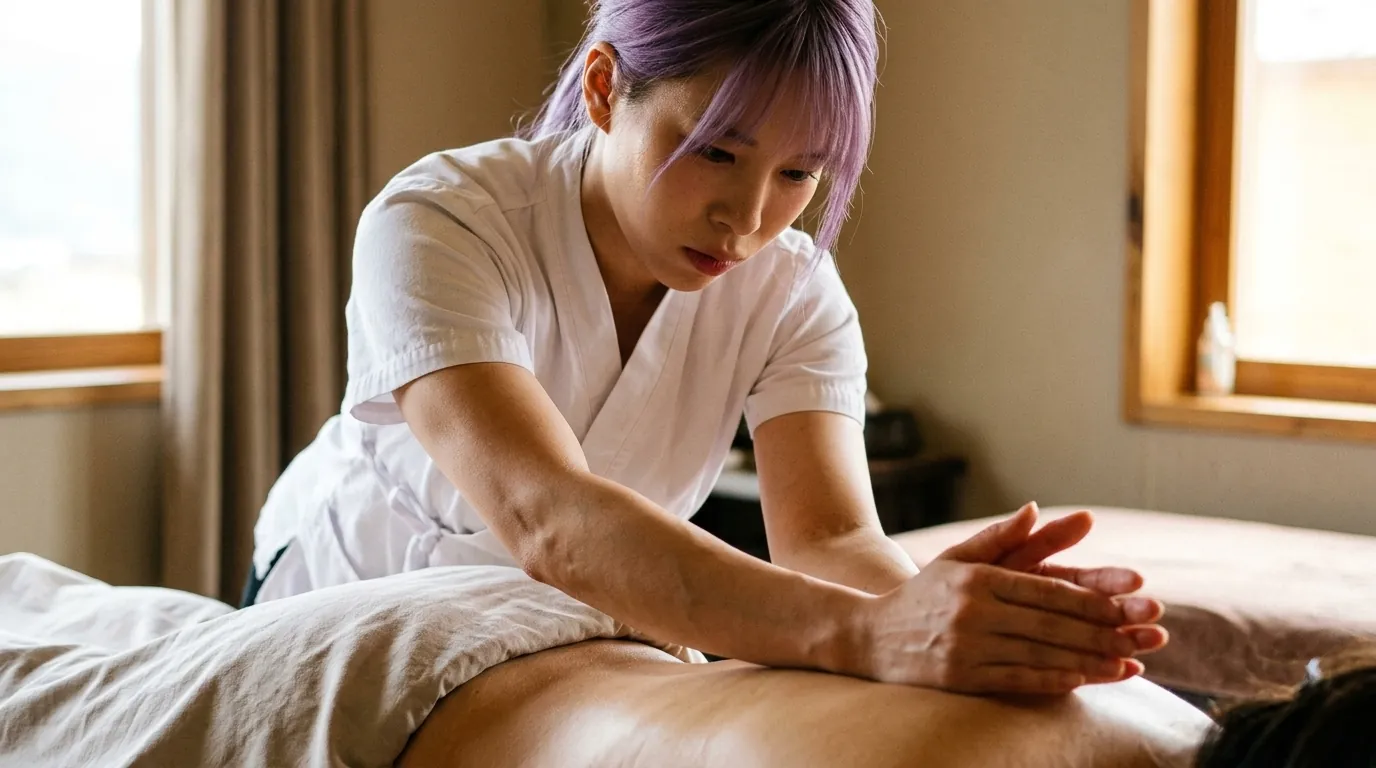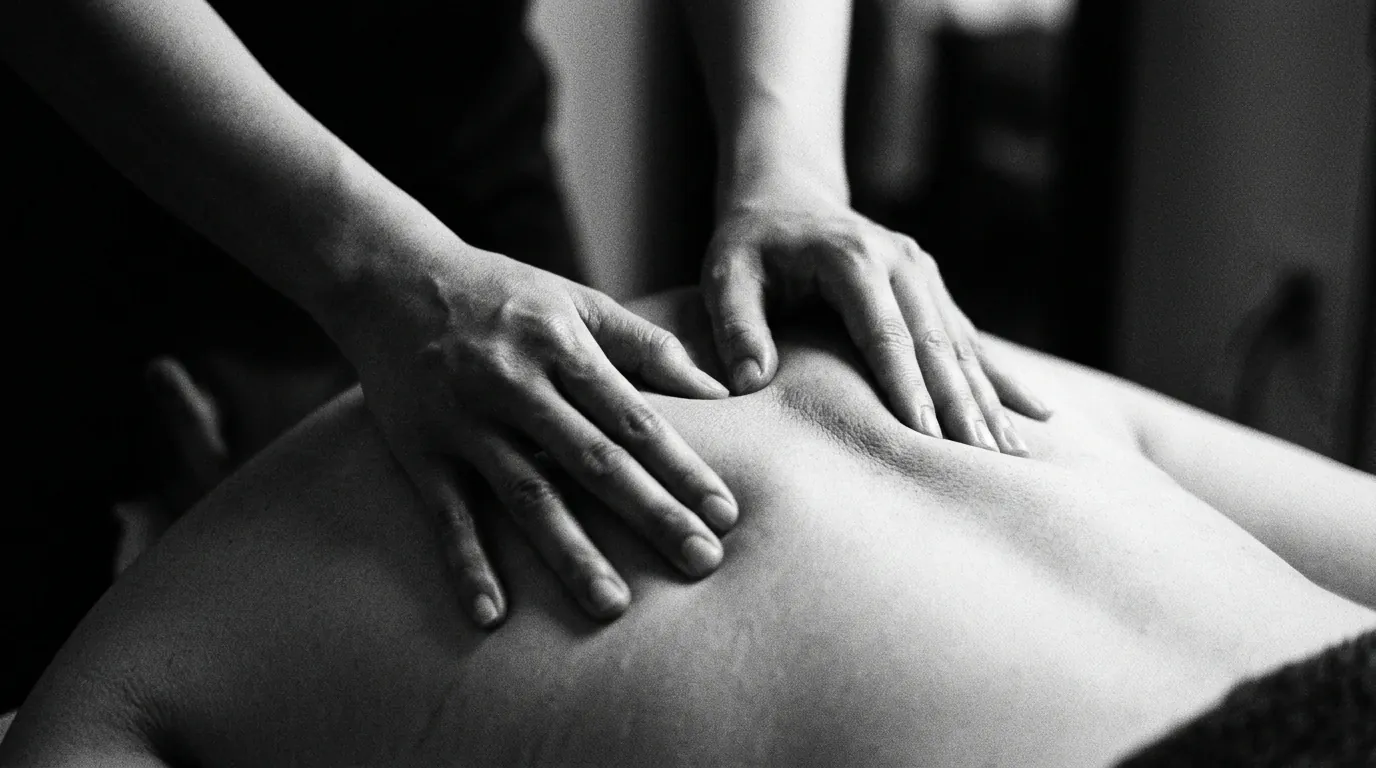
Deep tissue has a reputation it never really earned. People arrive braced, expecting to grit their teeth the whole way through, because somewhere along the way firm pressure got confused with pain. The depth in this treatment comes from patience, not force.
Deep tissue massage uses slow, sustained pressure to reach the muscle layers beneath the surface. The depth comes from how long the practitioner stays with one area, not from how hard they push. A session usually covers fewer parts of the body than a relaxation massage, because each area is given more time. It should feel firm and purposeful, not painful.
What does deep actually mean here?
Deep describes depth of contact, not amount of effort. Muscle sits in layers. The ones nearest the surface answer quickly to touch and warmth. The ones underneath take longer to settle, and they do not give way to a hand that arrives in a hurry. So a practitioner working deeply moves slowly, sinks in gradually, and then waits at that depth rather than pushing past it.
The waiting is the technique. Pressure applied quickly meets resistance, because the body braces against anything sudden. Pressure applied slowly is met differently. You feel the contact arrive, your breathing catches up with it, and the area eases under the hand. The practitioner follows that easing rather than forcing it.
This is why deep tissue massage is described as firm and focused rather than strong. Strength is not really the variable being adjusted. Speed is.
Does a deep tissue massage have to hurt?
No. There is a difference between a sensation that is strong and one that is sharp, and learning to tell them apart makes the whole hour more useful.
Strong feels like a lot, but you can breathe through it. Your jaw stays loose. You might call it satisfying afterwards, or the good sort of uncomfortable. Sharp is another thing entirely. You hold your breath, your shoulders lift towards your ears, and you begin waiting for it to be over. Once you are waiting for it to be over, nothing useful is happening, because the area you came in for is now guarded.
If you catch yourself bracing, say so. One word is enough. Any practitioner would far rather adjust early than learn at the end that you spent the rest of the session quietly enduring. If you are not sure how to put it in the moment, there is a small vocabulary for this and it takes about a minute to pick up.
It also helps to know that the strongest moment of a stroke is usually brief. Pressure in this kind of work tends to arrive, hold for a handful of breaths, then lift. If you can feel that shape, the intense part becomes much easier to stay with, because you are no longer bracing against something that might go on indefinitely.
Why does a deep tissue session cover less of you?
A relaxation massage travels. Long strokes move across the back, down the legs, along the arms, and by the end most of you has been touched. A deep tissue session does not work that way. Time spent slowly in one place is time not spent everywhere else.
If your shoulders are the reason you booked, a shorter session may go almost entirely to your neck, shoulders and upper back, with a little at the hips because hips tend to have opinions about shoulders. That is not the massage being unfinished. That is the massage being spent where you asked for it.
So it is worth deciding before you lie down. Two or three areas is a realistic ask for a shorter treatment. A whole body at depth is not, and anyone promising it is simply going faster, which puts you back in surface work with more weight behind it. If you want both coverage and depth, the longer length is the honest answer, and choosing between the two lengths is mostly a question of how much ground you want covered.
One more thing follows from the same arithmetic. Because the session is narrower, the conversation at the start matters more than it does in a relaxation treatment. Saying that your right shoulder is worse than your left, or that you would rather nothing was done to your feet, genuinely changes how the time is spent. Vague answers get an even spread, which is the one thing deep tissue is not for.
What does deep tissue feel like from the table?
- The first few minutesMostly warming. Broad, unhurried strokes over the whole area so that nothing arrives cold. It can feel almost like a gentle massage at this stage, and that is deliberate.
- Finding the areaThe pace drops. Your practitioner works with a forearm, a thumb or the heel of the hand, moving very slowly across one region and pausing wherever the tissue holds.
- The sustained partContact stays in one place while you breathe. This is the part people remember. It is strong and very specific, and it usually eases within a few breaths rather than building.
- Moving onThe pressure lightens and travels, then the cycle begins again somewhere nearby. Most sessions alternate like this rather than staying deep from start to finish.
- The last stretchBroader, lighter work again, so you are not sent back into your day still carrying the intensity of the deepest section.
Work with it, not through it
That phrase gets used a great deal in this kind of treatment, and it means something practical. Working through a tight area means deciding in advance where the pressure is going and pushing until it arrives. Working with it means arriving, feeling what the area is willing to give that day, and taking that instead.
Bodies are not consistent. A shoulder that softened beautifully last month may be stubborn this month, for reasons neither of you can name. A practitioner working with you adjusts to the body that turned up. One working through you is following a plan while you happen to be underneath it.
The pressure is not the point. The pause inside the pressure is.
On firm work
How does it sit against the other treatments?
It lives at the firm end of the menu, but firm is not the only axis worth thinking about. Swedish massage is gentler and keeps moving, so it covers more of you and asks less of your attention. Thai combination massage meets tension from a different direction, through assisted stretching and pressure applied along the body rather than sustained work in one spot, so it can feel every bit as strong with far less of the sinking-in sensation.
If you are weighing the firm options against each other, the side-by-side comparison takes that choice apart properly, and the pressure guide covers how to pitch a level across all five treatments.
When to check with your doctor first
Massage is not medical treatment, and nobody at a spa is in a position to give you medical advice. Anyone who is pregnant, recovering from an injury or managing a medical condition should speak to their doctor first, and tell the practitioner before the session begins. Bring what your doctor has told you with you, and the pressure will be planned around it.
There is a plainer version of the same idea. If somewhere already hurts before anyone has touched it, slow sustained pressure on that exact spot is rarely the first thing to try. Say what is going on at the start, and the session can work around it.
So is it the right choice for you?
Deep tissue suits you if you already know where you hold tension, you like the feeling of being worked on rather than soothed, and you would rather have two areas done properly than all of you done quickly. It suits you less if what you actually want is a stretch of time not thinking about anything, in which case the gentler end of the collection will serve you better.
Either way, nothing about the decision is final. Pressure gets adjusted mid-session all the time, and nobody keeps score. The full collection is there whenever you want to weigh one treatment against another and settle on the kind of hour you are after.
Common questions
Will I be sore the next day?
Some people notice a mild tenderness the following day, a little like the feeling after unfamiliar exercise. Most describe it as mild and short-lived, and plenty of people feel nothing at all. If it was properly uncomfortable rather than mild, that is useful information for next time, and asking for less pressure is a perfectly ordinary request.
Is deep tissue a good choice for a first massage?
It can be, if you already know you like firm pressure on your shoulders or back. If you have never been on a massage table, it is often easier to start somewhere gentler and move up, because firm is a relative word until you have a reference point. Either choice works, and pressure is adjusted inside the session anyway.
What is the difference between deep tissue and a Swedish massage at firm pressure?
Pace and intent. A Swedish massage at firm pressure still travels, covering the body with strong but continuous strokes. Deep tissue slows down and stays, spending several minutes in one region before moving on. You can ask for firmer pressure in any treatment, but you are asking for a different way of working when you book deep tissue.
Should I eat before a deep tissue massage?
Something light an hour or two beforehand tends to be the most comfortable option. A full meal is awkward when you are lying face down, and an empty stomach has a way of making itself heard in a quiet room. Beyond that, no special preparation is needed.
Can I ask for deep work on just one area?
Yes, and it is one of the better ways to spend the time. Naming one or two places at the start lets your practitioner plan the whole hour around them. The alternative is discovering near the end that your lower back was the real reason you came.