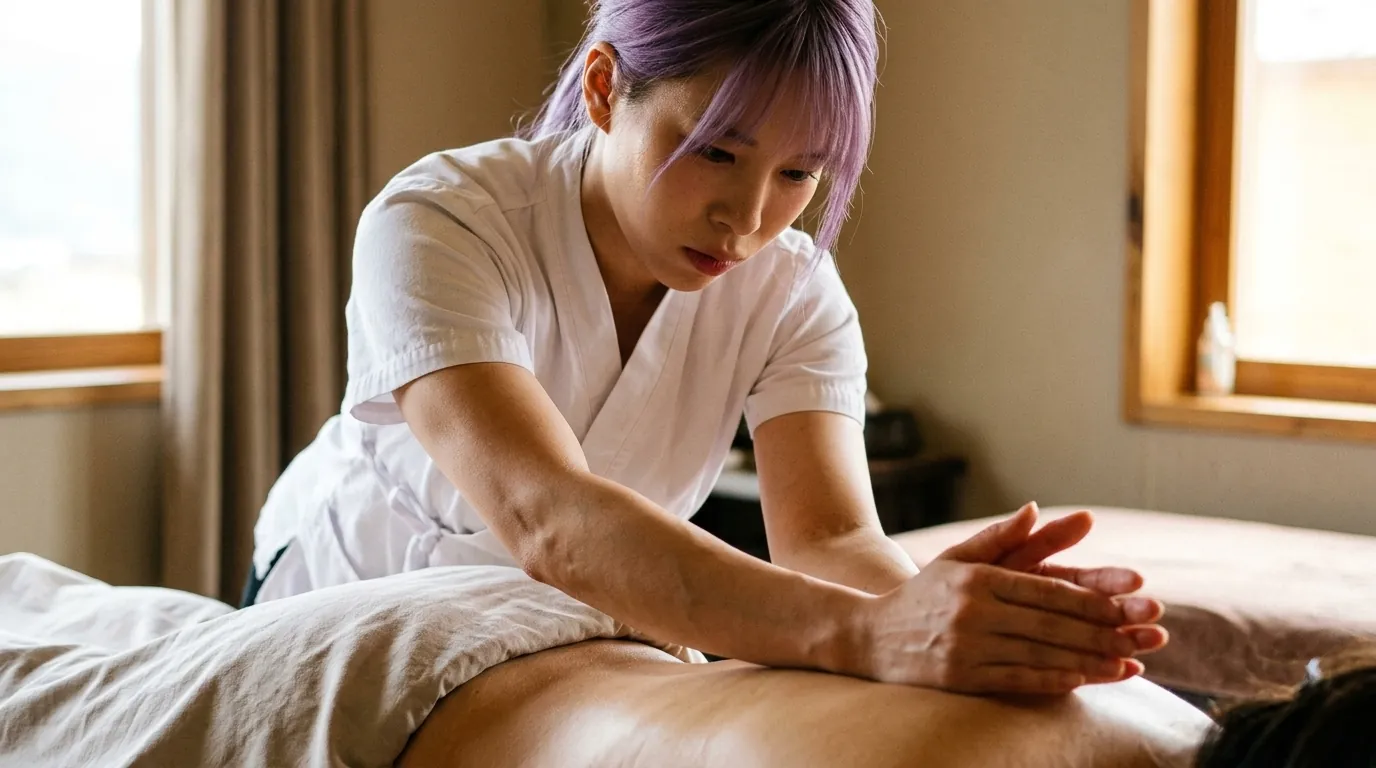
Nobody choosing between these two is really asking which massage is better. The question underneath is how much pressure you want to be under for an hour, and whether you would rather drift off or stay awake for it. One treatment is gentle and continuous. The other is slow and firm.
Swedish massage uses long, flowing strokes and gentle to medium pressure across the whole body, and tends to leave you drowsy and light. Deep tissue works slower and firmer in fewer places, giving hard-working muscles focused attention. Choose Swedish when you want to switch off completely. Choose deep tissue when one particular area has been asking for attention.
What is the difference between Swedish and deep tissue massage?
The difference is not really the list of techniques. Both treatments use hands, forearms and oil. Both can cover you from shoulders to feet. The difference is what the hour is organised around. A Swedish massage is organised around rhythm: long strokes travelling the length of a limb or the back, an even pace, an hour designed to be continuous rather than eventful. A deep tissue massage is organised around places. The practitioner slows right down, sinks in gradually, waits somewhere until the tissue softens a little, and then moves on.
Pressure is the part everyone asks about, and it is the smaller half of the answer. Speed matters more than most people expect. Firm pressure applied quickly is unpleasant. The same weight applied slowly, with warning, in time with your breathing, usually is not. That is why deep tissue covers less ground in the same hour. The time has gone somewhere else.
| Swedish massage | Deep tissue massage | |
|---|---|---|
| Pressure | Gentle to medium, steady throughout | Firm and focused, building gradually in chosen areas |
| Pace | Flowing and continuous | Slow, with pauses where the work is happening |
| Coverage | Full body, fairly even attention | Full body, but a few areas take most of the hour |
| What the practitioner is doing | Long strokes, gentle kneading, rhythm | Sustained pressure, small deliberate movements, working with your breath |
| How talkative the hour tends to be | Often near silent after the first few minutes | More back and forth, because pressure needs checking |
| How you tend to feel afterwards | Drowsy, light, reluctant to stand up | Looser where the work was, occasionally a little tender the next day |
| Often chosen by | People who want to switch off and stop thinking | People with one or two places that have been nagging at them |
It is worth knowing that both names are used loosely across the industry, which is part of why people arrive confused. Swedish has become a general word for relaxing massage, and deep tissue has become a general word for anything firm. Treat them as descriptions of intent rather than strict recipes. What decides your hour is not the label on the menu but the two minutes of conversation before it starts.
How each hour actually goes
A Swedish hour
You lose track of the sequence early on, and that is rather the point. The strokes are long enough that you stop noticing where one ends and the next begins. There is no moment that asks anything of you. Nothing needs deciding, nothing needs reporting, and the conversation usually stops within the first few minutes because there is nothing to negotiate. People often describe the last twenty minutes as half asleep, aware of the room but not really in it.
A deep tissue hour
This one has structure you can feel. The practitioner warms an area first, then settles into it, and the pressure builds over several seconds rather than arriving all at once. You will be asked how it feels, probably more than once, and your answer genuinely changes what happens next. Between those stretches of focused work there are easier passages while they move on to the next place. It is an hour you stay slightly more present for, and some people prefer that.
The rest of the day
The two treatments leave you in different states, and it is worth planning around that. After a gentler session most people want quiet, a slow walk, nothing that involves being sharp. After firmer work people often feel oddly energetic for an hour and then very ready to stop. Neither combines well with something demanding immediately afterwards, which is the real argument for booking at the end of a day rather than the middle of one. What to do either side of a session goes into that properly.
Choose Swedish massage if this sounds like you
You are tired rather than sore. You have had a long stretch of weeks and what you want is an hour where nobody needs anything from you. You would rather feel warm and unhurried than worked on. Perhaps this is your first massage and you have no idea yet how you feel about someone leaning into your shoulders. Perhaps you are going somewhere afterwards and would prefer to leave feeling soft rather than slightly rearranged. Swedish is also the better choice on the days when your whole body wants attention and no single part of it is complaining louder than the rest.
- You want to relax rather than address anything in particular
- You are new to massage and would rather start gently
- You dislike the idea of firm pressure, or have simply never enjoyed it
- You want even attention across the whole body in one session
Choose deep tissue massage if this sounds like you
There is a place. You could point to it right now without thinking. It might be between the shoulder blades, along the side of the neck, or low in the back, and it has been there long enough that you have stopped mentioning it. You have had gentler massages and enjoyed them, but left with the feeling that nobody quite got to the thing. You do not mind pressure that makes you breathe out slowly. You would rather spend the hour on three places properly than eleven places lightly. If that is you, firmer and slower is the treatment that matches what you are actually asking for.
- One or two areas have been bothering you for a while
- Gentler massage has felt pleasant but not quite enough
- You are comfortable being asked about pressure and answering honestly
- You would trade full-body coverage for focused attention
What if you want a bit of both?
Then say so when you arrive, because this is more common than either of the clean descriptions above suggests. A Swedish massage with ten minutes of firmer work across the shoulders is a perfectly ordinary request, and so is a deep tissue session that finishes with lighter, flowing strokes so you are not walking out cold. What you cannot have is an hour that is genuinely both throughout. Slow focused work takes time, and every minute spent there is a minute not spent covering the rest of you. Being clear about which way you want the balance to lean is most of telling a practitioner what you want.
If it is stretching rather than pressure that appeals, that is a different comparison altogether and the Thai Combination and deep tissue question is the one to read instead.
Is deep tissue just Swedish massage with more pressure?
This is the assumption most people arrive with, and it is worth taking apart, because it leads to a lot of disappointed hours. Pressure is a dial, and it exists in both treatments. You can ask for firmer work in a Swedish session and you will get it. What you cannot ask for is more time, and time is the thing deep tissue actually spends differently.
Think of it as two separate decisions rather than one. The first is how much weight you want behind the hands. The second is whether you want the hour spread evenly across you or concentrated in a few places. Swedish with firm pressure is still an even hour. Deep tissue at medium pressure is still a concentrated one. People who book deep tissue purely because they like firm pressure often find they miss the coverage, and people who ask for a gentle deep tissue session are usually describing a Swedish massage without knowing it.
Firmer is not better, it is simply a preference, and the honest test is whether you can keep breathing normally rather than how much you can stand. Where each treatment tends to sit on that scale is set out properly in the guide to massage pressure.
Which one should you book first?
If you genuinely cannot decide, book the gentler one. Swedish tells you a great deal about your own preferences with very little risk of an hour you did not enjoy, and it is easy to ask for firmer pressure partway through if you find yourself wanting more. Going the other way is harder. A deep tissue hour that turns out to be more than you wanted is a long time to lie there being polite about it.
Length matters less than people assume at this stage, though a longer session does give a deep tissue practitioner room to work properly rather than choosing between areas. That trade-off is covered in the sixty or ninety minute question. When you have made up your mind, or decided to start gently and see, you can look at the treatment menu and pick your moment.
Common questions
Is deep tissue massage supposed to hurt?
No. There is a difference between pressure you can breathe through and pressure you are bracing against, and only the first one is useful. If you are holding your breath or gripping the table, the pressure has gone past where it should be and you can say so straight away. A good hour of firm work feels intense in places and completely fine everywhere else.
Does a deep tissue massage cover the whole body?
It can, and usually does, but not evenly. The practitioner still works down the body, yet two or three areas take the bulk of the time and the rest gets a lighter pass. If there is somewhere you particularly want included, say so at the start rather than hoping it comes round, because the hour gets allocated early.
Which one is better for a first massage?
Swedish is the easier introduction. It is predictable, it covers the whole body, and it asks nothing of you beyond lying still. Once you know how your body responds to being worked on, you are in a much better position to judge whether you want something firmer next time.
Will I be sore after a deep tissue massage?
Some people notice a dull, worked feeling in the areas that had the most attention, usually the next day, and usually mild. It tends to pass on its own. If it concerns you, mention it when you book again and ask for lighter work in those places.
Can I switch between the two on different visits?
Of course. Plenty of people book firmer work when something is bothering them and gentler work when they simply want an hour away from everything. There is no progression to follow and no reason to stay loyal to one treatment.