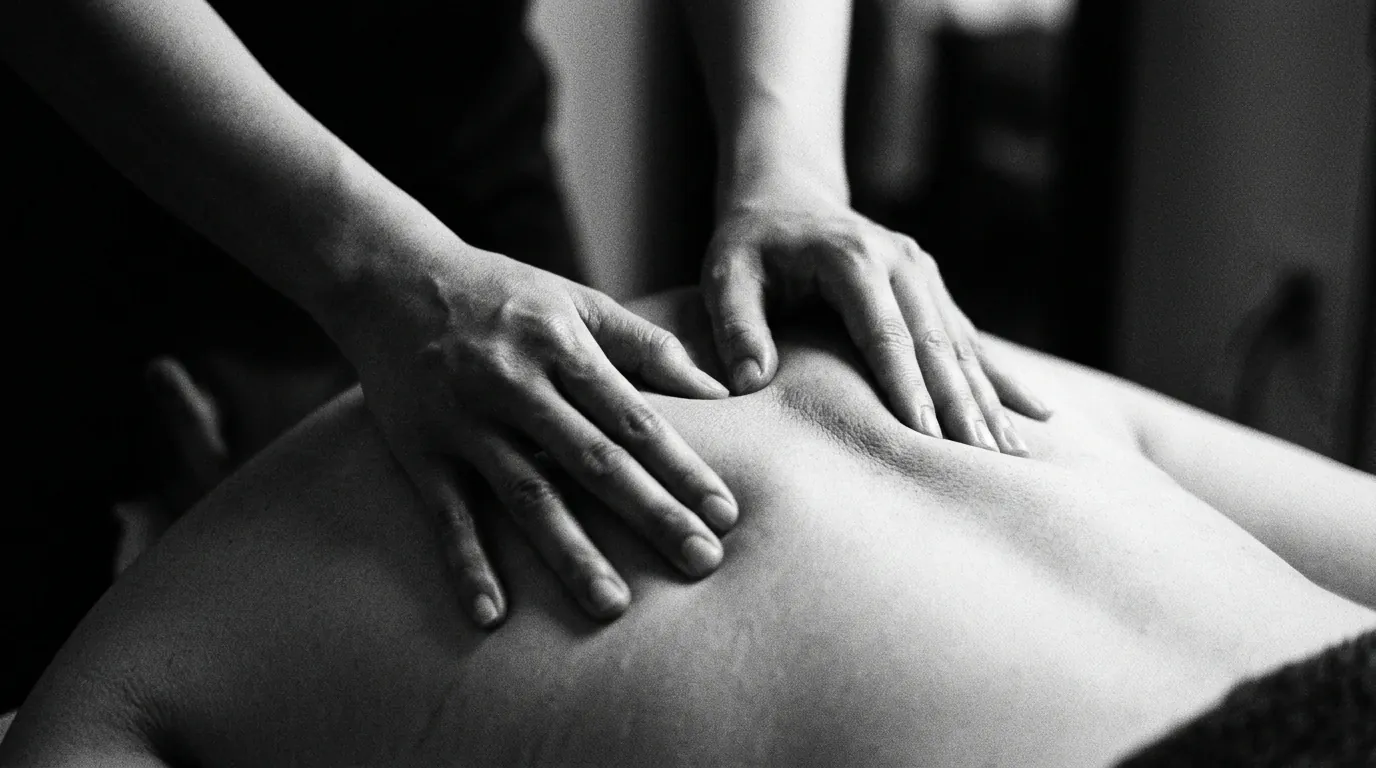
Two treatments, both at the firm end of the menu, and a choice that has very little to do with pressure. Thai Combination and Deep Tissue are the two places people land when a gentle massage is not quite what they want. What separates them is simpler than most comparisons suggest: in one you lie still and breathe, and in the other you are moved.
Thai combination massage and deep tissue massage both use firm pressure, so the real difference is movement. In a Thai combination session your practitioner moves you, guiding your limbs through assisted stretches alongside oil work. In deep tissue you stay still while slow, sustained pressure works one area at a time. Choose by how active you want to be.
What is the real difference between Thai combination and deep tissue?
Pressure is the first thing most people ask about, and here it is the least useful question. Both treatments are described as firm. Both will meet you with real weight if you want it, and both will ease off if you say so. You cannot choose between them on a pressure scale, because they occupy roughly the same part of it. If pressure is what you are still trying to work out, the pressure guide covers that separately.
The variable that actually separates them is movement. Deep tissue is a still treatment. You settle into one position and stay there while someone works slowly through a small area. Thai combination is a moving treatment. Your arm is lifted, your leg is folded, your shoulder is rotated, and the work happens partly through how you are being held and where you are being taken.
That one difference changes almost everything else about the hour: the pace, how much of the body gets covered, how involved you feel, and what you notice when you stand up.
What does a deep tissue session actually feel like?
It feels slow. That is the part people are least prepared for. A practitioner working deeply does not move quickly, because speed and depth do not go together. A single forearm stroke along one side of the back can take longer than an entire passage of a relaxing massage, and then it might be repeated, a little further in.
Attention narrows. Rather than a full tour of the body, you get a shoulder, a hip, a stretch of the upper back, given far more time than a general massage would ever allow. Your role is to stay put, keep breathing, and say something when the pressure stops feeling useful. People often describe the sensation as a strong, dull ache that sits just the right side of comfortable, then releases as the hold continues.
You do very little. If lying still while somebody works patiently on one spot sounds restful rather than frustrating, this is your treatment.
What does a Thai combination session actually feel like?
It alternates. A Thai combination blends acupressure, assisted stretching and oil work, so the hour has a rhythm to it rather than a single sustained note. Pressure is held along a line, then the area is opened out with a stretch. Your knee is drawn towards your chest. Your arm is taken out to the side and held there. Then the oil work smooths back over what has just been moved.
You are a participant, though a passive one. The practitioner does the lifting and you do the letting go, which is harder than it sounds the first time. Most people hold a limb up slightly without realising, and the usual instruction is to let it get heavy. Once that clicks, the session tends to feel less like being worked on and more like being taken through something. The full shape of the treatment is covered in what a Thai combination massage involves.
More of the body gets touched, and a session commonly ends with a sense of having more room to move rather than one spot feeling looked after. Whether this happens on a mat or a table varies by treatment and by spa, and the mat or table question is worth a look if the setting matters to you.
Thai combination vs deep tissue at a glance
| Thai Combination | Deep Tissue | |
|---|---|---|
| Your body | Moved, lifted and repositioned throughout | Still, in one position at a time |
| Your role | Let limbs go heavy, follow the practitioner's lead | Stay settled and keep breathing |
| Pace | Alternating: press, stretch, smooth, move on | Slow and sustained, one area at a time |
| Coverage | Broad, most of the body gets attention | Narrow, concentrated where you ask |
| Pressure | Firm, arriving in waves | Firm, held for long stretches |
| Often described afterwards as | Loose, mobile, more range to move | Worked, eased, specific spot addressed |
| Suits you if | Stiffness is general, or stillness makes you restless | One area is asking for attention and you want quiet |
Which one should you book?
Start with what you would point at. If you can put a finger on the place that bothers you, deep tissue is built for that. Give a practitioner one shoulder and an hour and the whole session can go there. Spreading that same hour across the body would waste what makes the treatment worthwhile.
If you cannot point at anything in particular and would instead say you feel generally stiff, closed up, or like you have not moved properly in weeks, the Thai combination usually suits better. That kind of stiffness rarely sits in one place, so an hour spent in one place rarely feels like the right answer to it. The same logic applies if you have been travelling, or if your week already includes training and what you want is something that fits around it.
Temperament matters more than people expect. Some guests find being repositioned intrusive and would rather be left alone to sink into a table. Others find an hour of lying still on one spot slightly maddening and are much happier when something keeps changing. Neither reaction is wrong, and it is a fair reason to choose.
Can you alternate between the two?
Plenty of people do, and it is a sensible pattern rather than an indecisive one. The two treatments answer different complaints, and your body does not present the same complaint every month. A stubborn shoulder after a heavy work period asks for one thing. A general sense of having seized up asks for another.
A practical approach is to let the booking follow the week you have just had rather than a fixed rotation. If you are trying to work out a sensible rhythm in the first place, how often to come back covers that ground properly.
How do you ask for the right one on the day?
- Name the area, not the techniqueSay where it is and how long it has been like that. Practitioners can choose the method. What they cannot guess is which part of you has been quietly annoying for three weeks.
- Say whether you want to be movedThis is the one sentence that saves a session. Something as plain as I would rather stay still, or please do move me about, tells a practitioner more than a list of muscle names.
- Set your pressure ceiling earlyDescribe the point where firm stops being useful for you. It is much easier to set that boundary at the beginning than to renegotiate it halfway through.
- Speak during, not afterAdjustments are normal and expected. A quiet word mid-session costs nothing, and it is far better than a polite hour you did not enjoy.
If the wording is the awkward part, saying what you want goes through it in more detail.
A word on aches, injuries and anything medical
Neither of these treatments is medical care, and a practitioner is not giving medical advice. If you are carrying an injury, managing a health condition, recovering from surgery or pregnant, speak to your doctor about whether massage is appropriate for you, and mention anything relevant before your session begins. Assisted stretching in particular involves your body being taken through ranges of movement, which is worth flagging if anything currently limits you.
The short version is that this is not a choice between gentle and strong. It is a choice between being still and being moved, and most people know which of those sounds better the moment it is put that way. When you have decided, the full treatment collection has both, with current lengths and details on each page.
Common questions
Is Thai combination massage softer than deep tissue?
Not reliably. Thai-style acupressure can be held with a great deal of weight behind it, and the stretches add their own intensity. The difference is that the firmness arrives in waves and moves around the body, rather than staying in one place for several minutes at a time.
Do I stay clothed for a Thai combination massage?
This treatment blends stretching with oil work, so it is not the fully clothed format some people picture when they hear the words Thai massage. If you want to know exactly how it will run before you lie down, ask at the start, and the practitioner will talk you through it. [[article:what-to-wear-for-a-massage|What to wear]] covers the general question.
Which one is better if I sit at a desk all day?
Many desk-bound guests prefer the Thai combination because stiffness from sitting tends to be spread across hips, back and shoulders rather than concentrated in one spot. If your discomfort has settled into a single stubborn area, deep tissue gives that one place far more time.
Can I ask for stretching during a deep tissue massage?
You can ask, and a practitioner may add some gentle movement where it fits. It will not turn into a Thai combination session, though, because the two treatments are built around different rhythms. If stretching is the part you actually want, book it directly rather than hoping it appears.
Which one leaves you more tender the next day?
People report tenderness after either, usually mild and usually short-lived, and it varies far more between individuals than between the two treatments. Deep tissue tenderness tends to sit in the specific area that was worked. After a Thai combination session it is more often a general, well-used feeling. Anything that feels sharp or lasting is worth raising with a doctor.