Much of what happens in a treatment room is decided before anyone touches you, and the largest of those decisions is what you are lying on. A floor mat and a raised table set a different distance between you and your practitioner, and that distance quietly decides what their hands can do.
A floor mat lets a practitioner use body weight, leverage and their own limbs to move you, which is why assisted stretching developed there. A table sets you at a fixed working height with a face cradle, which suits sustained oil pressure on a body that stays still. The mat is built for movement. The table is built for depth.
What is a massage mat?
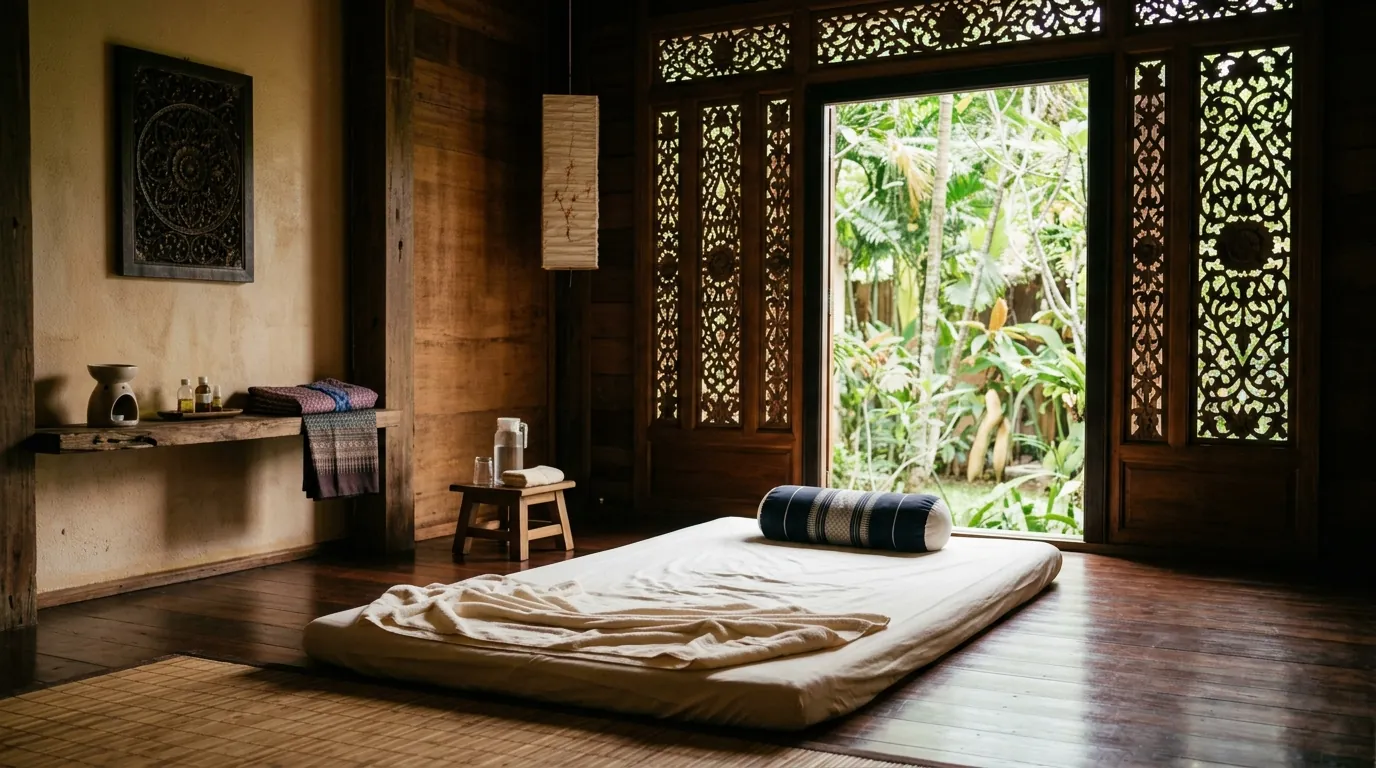
A firm padded mat, laid flat on the floor, wide enough that a practitioner can kneel beside you and still set a knee or a foot on the surface. It is not a cushion. Softness would be a fault, because a mat that sinks swallows the pressure aimed at you.
The width is the part people notice. A table is narrow so the practitioner can stand close to it. A mat is wide because on a mat you get moved, and your limbs need somewhere to be moved to. You stay dressed in loose clothing throughout, which is the other thing the surface decides, and the reason what you wear matters more for a floor session.
What does the table actually do?
It sets you at a working height, which sounds administrative and is the most useful thing in the room. At roughly the height of your practitioner's hips, they can stack a shoulder over their hand and let their own weight travel down a straight arm into you. Pressure delivered that way is steady and can be held. Arm strength alone fades within a minute.
This is why sustained work belongs on a table. A treatment like deep tissue massage depends on slow pressure staying exactly where it was put, and that needs a practitioner who is not fighting their own posture.
The table also has the face cradle, the padded horseshoe at the head end. It lets you lie face down without turning your head to one side, which is the difference between a neck that settles and a neck that quietly complains all session. A table takes oil, too, which a floor mat does not, and what a practitioner works with follows from that.
Why does Thai-style work want the floor?
Because stretching somebody is not something you do with your hands. It is something you do with your whole body, and you need somewhere to put it.
To guide your leg through a wide arc, a practitioner has to brace against something. On a mat that is the floor, their own shin, a knee set against your hip. They can move around you, change sides, kneel, stand, and lower their weight into a position rather than lift you into it. At waist height, on a surface barely wider than your shoulders, almost none of that is available. There is also nothing to fall off.
That is the practical reason the tradition grew up on the ground, and the longer story sits in the roots of Thai massage.
The surface is not the treatment. It is the amount of room the treatment is allowed to use.
What an adapted table session keeps, and what it gives up
Plenty of Thai-influenced work is now given on a table, and it is a fair adaptation rather than a compromised one. The thumb and palm pressure along the legs and back survives intact, as do the rhythm, the rocking and most side-lying and seated stretches. What narrows is the range: a limb travels only as far as the edge allows, and the practitioner cannot brace on the same surface you are on.
| What happens in the session | On a floor mat | On a table |
|---|---|---|
| Assisted stretching | Full range, the practitioner can brace and move around you | Limited to what fits within the table's width |
| Sustained deep pressure | Harder to hold for long from a kneel | Steady, weight travelling straight down from above |
| Lying face down | Head turned to one side on a flat surface | Face cradle keeps your neck in line with your spine |
| Oil work | Awkward, and hard on the mat | What the surface was designed for |
| What you wear | Loose clothing, on throughout | Undress to your comfort, covered with a towel |
A combination treatment sidesteps the question by holding both halves in one session. Thai Combination Massage pairs stretching and acupressure with oil work, so you are not asked to choose between being moved and being worked on.
How does the surface feel different from your side?
On a mat you are aware of being moved. You are rocked, rolled onto a side, lifted at the ankle, folded and unfolded. The floor underneath is flat and unarguable, and many guests find that steadying.
On a table you stay where you are put and the work comes to you. You sink rather than travel. For many people the shoulders drop the moment the face settles into the cradle and there is nothing left to hold up. Neither is the better experience. How firm the work is within either one is a separate question, covered in the guide to massage pressure.
Which one should you ask for?
Work backwards from what you want out of the hour.
- You want to be stretched and moved, and you like the loose feeling afterwards. The floor gives your practitioner the most room.
- You want slow, sustained attention in one or two places. The table is the more capable surface.
- You want oil, warmth and long strokes over the whole body. That is table work.
- You are pregnant, recovering from an injury, or managing a medical condition. Speak to your doctor about whether massage suits you at present. Your practitioner can adapt the setup and the pressure, but they are not giving medical advice, and would rather know beforehand than guess.
Small things that make either surface work better
- Let the cradle take your headMost people hold the neck slightly lifted for the first minute without noticing. Let the forehead rest down. If the cradle presses on your brow or cheekbones, ask for the angle to change, because it tilts and slides in seconds.
- Ask for a bolsterA padded roll under your ankles face down, or under your knees face up, takes the arch out of your lower back. If lying flat feels like work and none has been offered, ask.
- Let the limb go heavy on a matAlmost everyone helps at first, carrying a little of their own leg as it is lifted. A stretch only opens once the practitioner has the whole weight, and unlearning that changes a floor session more than anything else you can do.
- Name the half you want more ofWhere a session holds both stretching and oil work, say which you came for. The balance is easier to set at the start than to shift halfway through.
None of this needs deciding before you arrive. Look through the treatment menu and choose the experience you want rather than the furniture. The surface follows from it, and the rest is settled in the first minute.
Common questions
What is a massage mat made of?
It is a firm padded mat laid directly on the floor, usually a dense cotton or foam futon rather than anything soft. The firmness matters more than the thickness. A mat that sinks under you absorbs pressure that was meant for your muscles, so it is built to stay flat while someone leans on it.
Can Thai massage be done on a table?
Yes, and plenty of it is. An adapted table session keeps the pressure work, the rhythm and many of the seated and side-lying stretches. What it loses is the widest range of movement, because the edges of the table set a limit on how far a limb can travel and where the practitioner can stand. Most guests do not notice the missing range unless they have had the floor version first.
Why do massage tables have a hole for your face?
So that you can lie face down for a long stretch without turning your head to one side. The face cradle keeps your neck in line with your spine and leaves your nose and mouth clear to breathe. Its height and angle adjust, so if it presses awkwardly on your forehead or cheekbones, say so and it can be reset in a few seconds.
Is a floor mat less comfortable than a table?
It is different rather than worse. The floor is flatter and firmer, which some people find steadying, and there is no edge to be conscious of. The one genuine drawback is getting down to it and back up again. If that is difficult for you, mention it when you arrive and the session can be planned around a table instead.