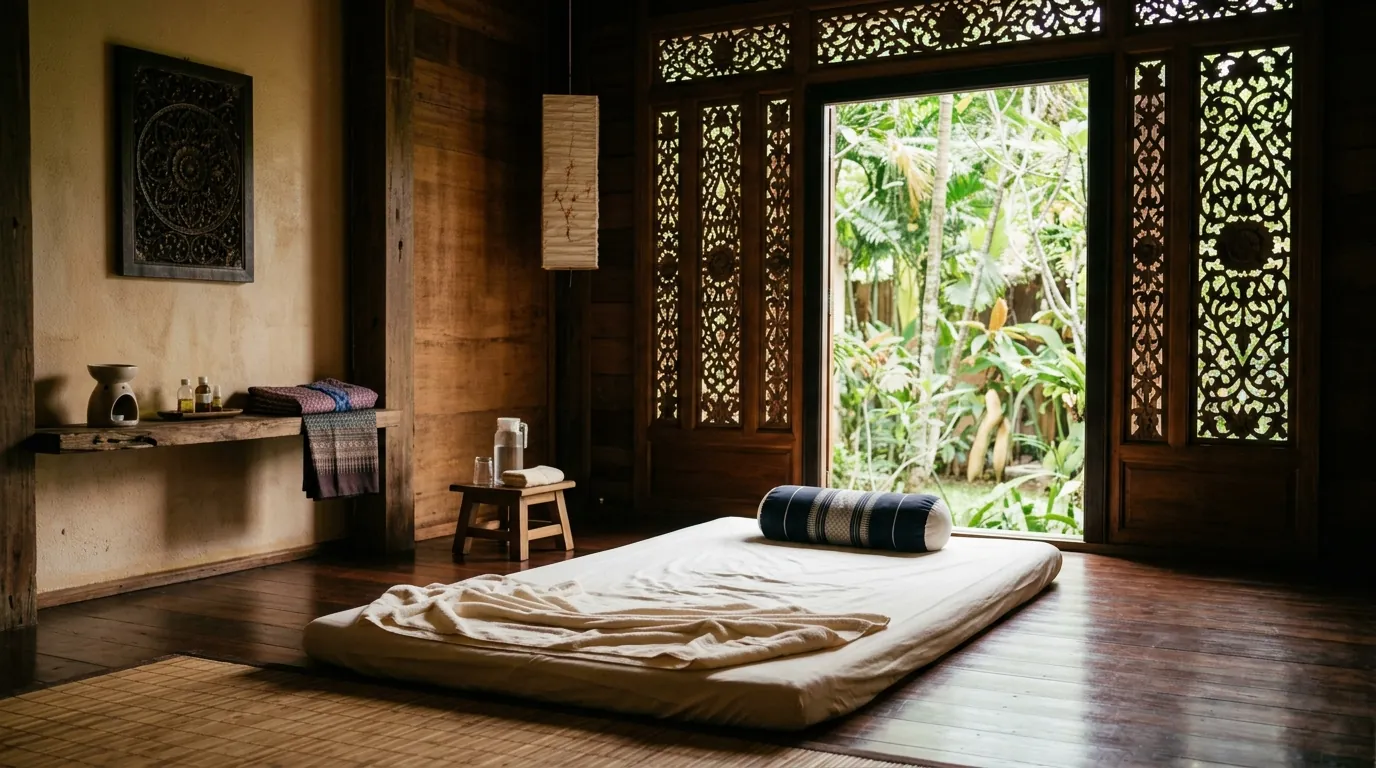
Thai massage is considerably older than the rooms it is now practised in. In Thailand the tradition is called nuad boran, usually translated as ancient massage, and for most of its life it was carried by temples and by families rather than by institutions. Knowing that explains the parts that look unusual the first time you see them. The clothes stay on. The mat is on the floor. The practitioner leans rather than rubs, and may use a forearm, a knee or a heel to do it.
Thai massage comes from a Thai tradition called nuad boran, meaning ancient massage. It was preserved largely in temples and within families, passed from teacher to student by hand rather than through textbooks, and practised on a floor mat with the guest clothed. Its written history is patchy and disputed, so what survives is mostly lineage and practice rather than documents.
What does nuad boran actually mean?
Nuad is the Thai word for massage, with a sense closer to pressing than to stroking. Boran means ancient, or traditional. Together the phrase names a whole body of practice rather than a single technique: pressure applied with thumbs, palms, elbows, knees and feet along lines mapped onto the body, combined with slow assisted movement of the limbs. You will also see it written as nuad thai, or simply given in English as traditional Thai massage. The naming shifts depending on who is speaking and where they trained.
The English word massage does some of the confusing work here. It tends to suggest oil, a table and a quiet hour. Nuad boran is closer to being worked through. You are pressed, rocked, folded and lengthened at a steady unhurried pace, and you stay dressed from beginning to end.
Where does the history actually begin?
The tradition honours a physician figure held to have been a contemporary of the Buddha, usually called Shivago or Jivaka, and many practitioners still open a session with a short homage to him. Whether the man described in those accounts had anything to do with the massage practised in Thailand today is not something anyone can demonstrate. It is a lineage story and it does the work of one. It tells a student that what they are being given was handed down rather than invented.
The documented record is thinner than the tradition's age suggests, and honest teachers say so. Thailand sits where Indian, Chinese and Southeast Asian ideas about the body met and mixed over a very long period, and the massage that emerged carries traces of more than one of them. A good deal of what had been written down is understood to have been lost when the old capital of Ayutthaya fell in the eighteenth century. What survives most visibly is the set of inscriptions and diagrams preserved at Wat Pho in Bangkok, the temple most closely tied to the practice and still a teaching centre. Anyone who gives you confident dates for the rest is filling gaps.
A practice that was never written down is not a practice without a record. The record is simply in hands.
Why was it kept in temples and families?
For most of its life the work had no colleges, no licensing body and no standard curriculum, so it lived in the two places that could hold it. Temples kept it as part of a wider tradition of care, taught among monks and to lay students, and it sat easily in monastic life because it asked for nothing but a floor and time. Families kept it as inherited knowledge. A grandmother's particular way of working on a back would go to whoever in the next generation showed an aptitude and the patience.
This is why there is no single correct version. Northern lineages, particularly those around Chiang Mai, tend towards slower flowing movement and larger stretches. Practice associated with Bangkok tends to be more static and more pressure led. Teachers within either differ from one another. When a practitioner describes something as their teacher's way of doing it, they are being precise rather than mysterious.
Why is it taught by hand rather than from a book?
You can read a description of a technique and still have no idea how much weight to lean in with, how long to wait before moving, or what a body about to resist feels like under your palm a second before it does. Those are the things an apprenticeship transmits. A student receives the work many times before ever giving it, learns positions by being put in them, and is corrected by touch rather than by notes in a margin.
- Weight rather than forcePressure in this tradition comes from leaning through a straight arm or a braced leg, not from squeezing. That is learned by feel, because it is the difference between deep work and a practitioner who is exhausted by noon.
- TimingKnowing how long to hold a point, and the pause before a stretch is taken any further, is most of what separates a rushed session from an unhurried one. No diagram carries it.
- Reading resistanceA limb tells you where its comfortable end is before the person does. The training is largely in noticing that early and stopping there.
- Sequence as conversationTraditional sequences are long and ordered, but a teacher shows a student when to depart from the order because the body in front of them is asking for something else.
Why is it practised clothed?
The feature that surprises people most has the plainest explanation. No oil is used at any point, so nothing in the work requires bare skin, and loose cloth gives a practitioner something to take hold of when they lift or fold a limb rather than a surface that slides. Loose cotton trousers and a loose top are what the traditional form asks you to wear.
There is a second reason, less often said aloud. The work grew up in rooms that were not private treatment rooms. A temple hall, a covered porch, a corner of a house with the family passing through. A practice given fully dressed in company needs no screen, no door and no explanation, and that is part of why it could be taught openly and given to anyone who turned up. The floor it is given on follows the same logic of needing nothing, though it earns its place for reasons of leverage too, which the mat and table question sets out properly.
What changes when the tradition moves into a spa?
Almost everything around the technique, and rather less of the technique itself. It is worth setting the two side by side plainly.
| Traditional nuad boran | Spa adaptation | |
|---|---|---|
| Setting | Floor mat, practitioner moving around and over you | Padded table at a fixed height |
| Clothing | Loose clothes, on throughout | Towel draping, with skin uncovered for the oil work |
| Oil | None at all | Warm oil for the gliding strokes |
| Length | Often two hours or more, unhurried | A set session length, shorter or longer |
| Shape | One long sequence learned from a teacher | Stretching and pressure blended with oil massage |
The Thai combination massage on the menu is an adaptation and says so. The Thai element in it is real. You are moved rather than asked to move, pressure travels along the lines rather than circling one knot, and the assisted stretches are the same shapes. What it does not do is keep you clothed on a mat for two hours, because it shares the session with oil work on a table. What that combination involves is set out in its own piece.
Something is lost in that translation and a tradition deserves to have it named. Length is part of the traditional method rather than an indulgence: a long sequence has time to go over the same ground twice, and the second pass is usually the one people remember. A shorter session chooses instead. What is gained is that the work reaches people who would never lie down on a mat for an afternoon, and who might otherwise never meet it at all.
What tends not to travel is the context. In Thailand the practice belongs to a larger set of customs, and it sits alongside ideas about the body that a spa menu cannot carry across in a sentence. The reasonable position is to be accurate about which of the two you are being offered, rather than dressing an hour on a table as something ancient. The technique is genuinely inherited. The hour is ours.
What is worth carrying into the room
Knowing the background will not change what you have to do, which is to say what you want and then stop managing it. It does adjust a couple of expectations. Movement is part of the work rather than an extra, so you will be handled more than you might expect. Pressure arrives slowly and leans in rather than digging. Nothing in the tradition asks you to be flexible, because the stretch is taken to your comfortable end and no further, and that end is different for everyone.
If origins interest you, the story behind Swedish massage is a very different sort of history: a contested attribution rather than a living lineage. And when the reading has done its part, the treatment menu is where to look next.
Common questions
Is nuad boran the same thing as Thai massage?
Broadly yes. Nuad boran is the Thai phrase, usually translated as ancient or traditional massage, and you will also see nuad thai used. English speakers tend to say Thai massage for all of it. The one place the words part company is in spas, where Thai massage is often shorthand for a shorter adapted session on a table rather than the traditional clothed form.
Why do some practitioners say a few words before starting?
Many lineages open with a short spoken homage to the physician figure the tradition honours, sometimes silently and sometimes aloud. It is a gesture of respect towards the teachers the practice came through rather than anything you are expected to join in with. If it happens, you simply lie still.
Is there one authentic style of Thai massage?
No, and practitioners are usually clear about that. Northern lineages tend towards slower movement and larger assisted stretches, while practice associated with Bangkok tends to be more static and more pressure led. Individual teachers differ within both. What you receive reflects who taught the person working on you.
Does a spa version count as real Thai massage?
It is an adaptation and worth describing as one. The technique carries over honestly, but the setting, the length and the clothing usually do not. A shorter session on a table with oil is a genuine descendant of the tradition rather than a reproduction of it, and there is no need to pretend otherwise.
Do I need to know any of this before a session?
Not at all. The background explains why the work looks the way it does, which some people find settling, but nothing in the room depends on it. Saying what you want and where you would rather not be worked on matters far more than knowing the history.