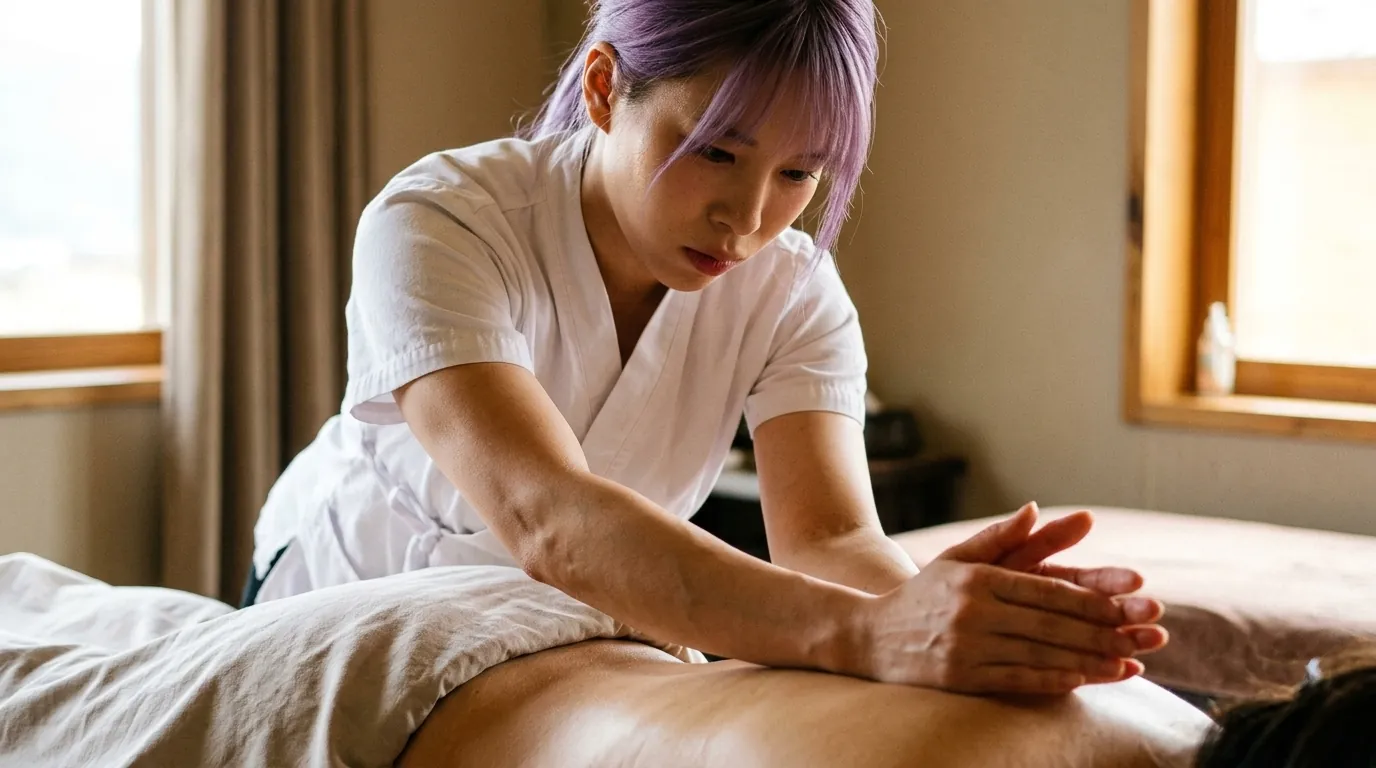
Most histories of massage are histories of a practice. This one is mostly a history of a word. The treatment on the menu is real and well defined, but the name attached to it has drifted a long way from the thing it originally described, and the drift is more interesting than a tidy origin story would be.
Swedish massage takes its name from a nineteenth-century Swedish system of exercise and prescribed movement, not from the oil massage sold under that name today. The five classical strokes carry French names, the usual attribution to a single inventor is contested, and in Sweden the same treatment is generally called classic massage. The label travelled further than the method did.
Why are the strokes French if the massage is Swedish?
Effleurage, petrissage, friction, tapotement, vibration. Five terms. Three of them are unmistakably French, and the other two are simply the words that translated. This is the loose thread in the whole story, and pulling it unravels the name.
The plain explanation is that French was a working language of European medicine and science through much of the nineteenth century, so when the manual techniques were written up and taught, they were written up in the vocabulary of the room they were written in. A stroke had to be called something before it could be taught to a stranger. The names that stuck were the ones that made it into print.
What that tells you is that the naming happened somewhere other than the origin. If the technique had been codified in Stockholm by the man whose country ended up on the label, the terms would almost certainly not be French. They are a fingerprint left by whoever did the sorting, and the sorting is a different job from the inventing.
What did Per Henrik Ling actually teach?
Ling is the figure the name points back to. He was a Swedish fencing master and teacher of gymnastics who founded an institute in Stockholm in the early nineteenth century, and the system he built there spread across Europe under labels like the Swedish movement system. His institute trained teachers, and teachers travel, which is how a Swedish word ended up on menus in cities that never saw the place.
The part that surprises people is what the system mostly consisted of. It was movement. Exercises, positions, resisted and assisted motion, a practitioner moving a limb through a range while the person either helped or stayed passive. Manual work existed within it, but it was one element of a programme rather than the whole treatment, and it looked very little like a sequence of oil strokes on a padded table.
If you want a modern point of comparison, the assisted movement in Thai Combination Massage is closer to the spirit of that original system than a classical oil massage is. Assisted movement did not disappear from massage; it simply kept its place in the traditions that never adopted the table.
So who invented Swedish massage?
The honest answer is that the question is badly formed, which is why it keeps producing different answers depending on who you ask.
The name most often offered alongside Ling is Johann Georg Mezger, a Dutch practitioner of the later nineteenth century, generally credited with organising the manual techniques into named categories and putting the French terms into clinical use. That attribution is contested. The terms appear in other hands and other places, the boundaries between the categories were never fixed, and untangling who first used which word in which sense is the kind of problem that keeps historians busy rather than the kind that gets settled.
What is not in dispute is the shape of the thing. A Swedish system of structured movement and exercise became widely known across Europe. Manual techniques circulating in the same period were sorted into a teachable vocabulary, in French, by practitioners working outside Sweden. The two streams ran together in the public mind, and the more famous name won the label.
How did a movement system turn into an oil massage?
Slowly, and mostly through teaching. A system survives in the form that is easiest to pass on, and hands-on strokes are far easier to pass on than a full programme of prescribed movement. One can be demonstrated on a table in an afternoon. The other needs a hall, a curriculum and a compliant student.
Through the twentieth century the manual half was formalised into training courses and the movement half largely went elsewhere, into physical therapy and exercise instruction, where it still lives under different names. What remained under the old label was the part that fitted in a treatment room: a table, oil, a covered guest, a sequence of strokes worked area by area.
That format is now so standard that it reads as timeless, which is usually a sign that something was standardised rather than inherited. The choice of surface is a good example of how recent some of it is, and the difference between working on a mat and working on a table shapes more of a treatment than most people expect.
| The label suggests | The history shows |
|---|---|
| A massage invented in Sweden | A Swedish system of exercise and prescribed movement that later lent its name to manual work |
| A single inventor | A contested attribution and decades of refinement across several countries |
| Swedish terminology | Five stroke names in French, from the language the techniques were written up in |
| An ancient traditional practice | A nineteenth-century European lineage, standardised into its present form much later |
| The name used in Sweden | Classic massage, with the Swedish label used mainly abroad |
What is Swedish massage called in Sweden?
Classic massage. Klassisk massage, if you are reading a Swedish price list. The national adjective is only informative from outside the country, which is the usual fate of these names: nobody calls it Swedish where everything is Swedish.
This is not a technicality. It is the clearest evidence that the word Swedish on a spa menu is doing a different job from the one it appears to be doing. It is not telling you where the treatment comes from. It is telling you which treatment it is, in a list where the alternatives are firmer, or assisted, or shared.
Does a contested history make the massage less genuine?
It makes it less mythological, which is a different thing and probably a better one. A technique that was argued over, taught, rewritten and standardised is a technique that a great many people found worth arguing about. The strokes earned their place by working on bodies, not by descending from anyone.
It also sets a useful expectation. Because the name marks a family rather than a fixed method, what a Swedish massage is depends a little on the room you are lying in, the training your practitioner had and what you asked for at the start. That is why the practical questions are the ones worth asking: how firm, how long, which areas. The five strokes and what each one feels like are set out in the plain guide to the treatment.
The contrast with a genuinely continuous tradition is instructive, and the roots of Thai massage tells a very different kind of story: one where the practice was handed down rather than assembled and renamed.
A name tells you where a treatment has been. Only the hour tells you what it does.
If the history has made you curious about the strokes themselves, Swedish massage sits on the treatment collection at more than one length, with no French required.
Common questions
Who invented Swedish massage?
There is no clean answer, and the sources disagree in a way that is worth noticing. Some point to Per Henrik Ling, whose Stockholm institute gave the name its Swedish half; others to the Dutch practitioner Johann Georg Mezger, usually credited with sorting the manual techniques into named categories. No single document marks a beginning, because the techniques were in circulation before anyone thought to write them down in order. Treat any confident single-inventor story as a simplification made for the sake of a tidy paragraph.
Is Swedish massage actually Swedish?
Only in the sense that the label was borrowed from a Swedish system. The strokes are named in French, the systematising work happened across several European countries, and the modern format was standardised later still through training curricula. It is a European inheritance with a Swedish flag on the box.
What is Swedish massage called in Sweden?
Classic massage, most commonly. The Swedish word is klassisk massage, and you would rarely see a Swedish spa advertise a Swedish massage, for the same reason a French bakery does not sell French bread. The name is mainly useful abroad, where it distinguishes this style from the others on a menu.
Does any of this history change the massage itself?
Not on the table. The strokes work the same whoever first wrote their names down. What the history changes is your expectations of the word: it tells you that Swedish massage describes a family of techniques rather than a national method, so the sensible question at a spa is which strokes and what pressure, not which country.