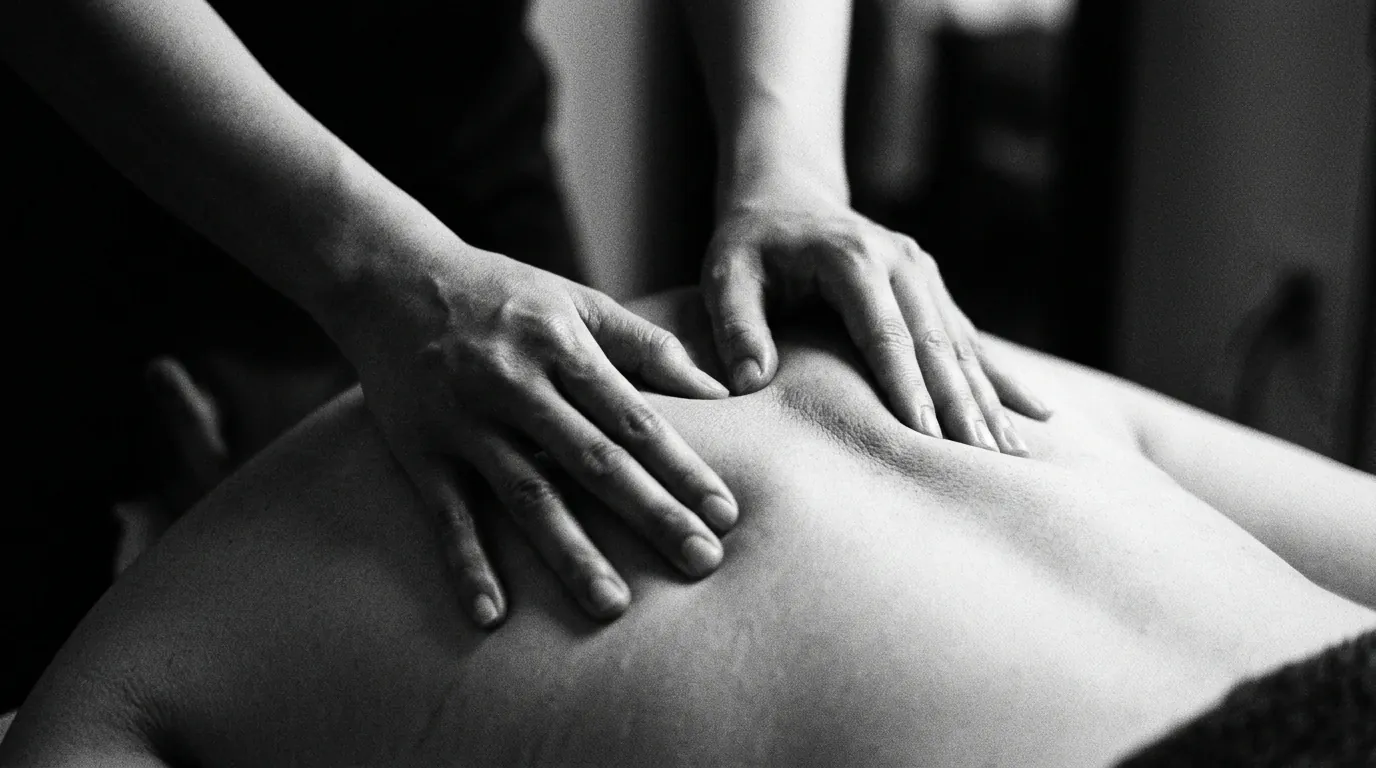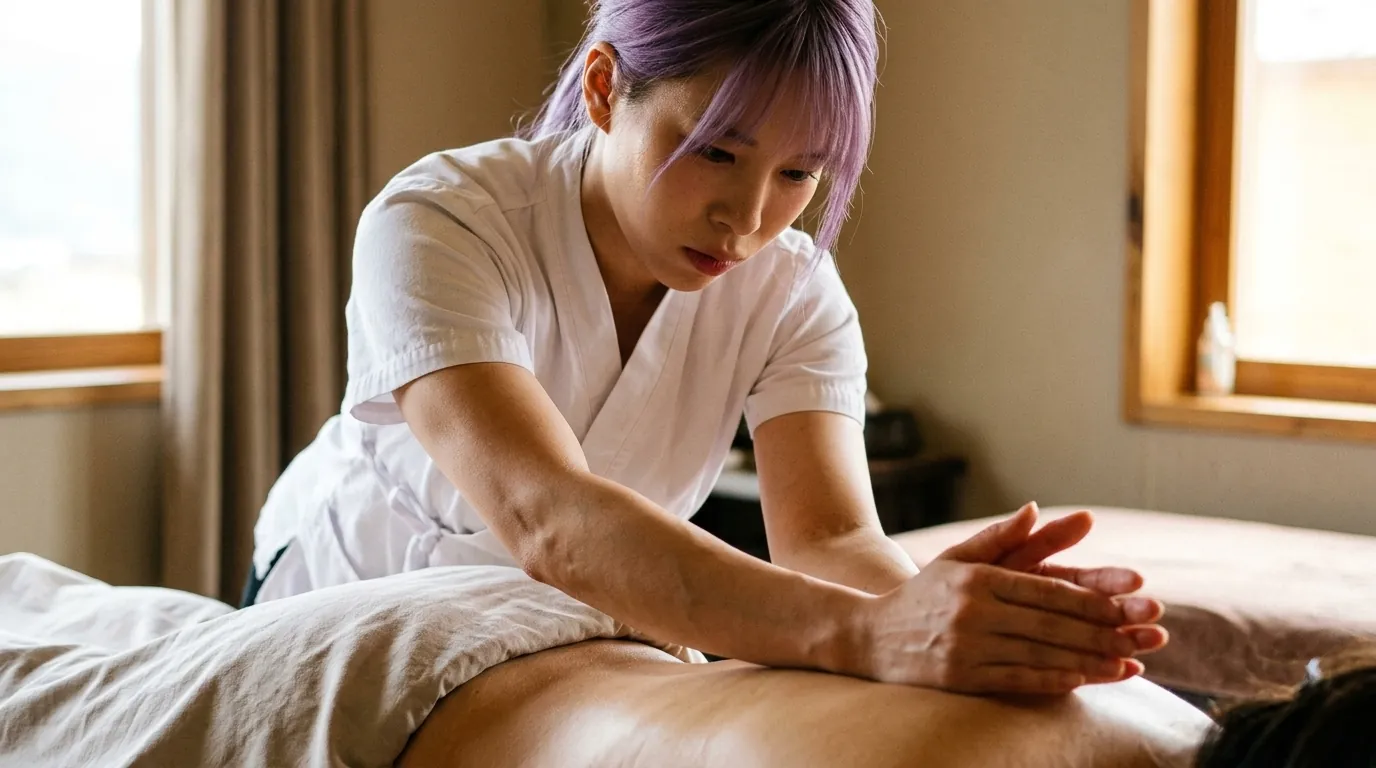
Swedish massage is the treatment most people picture when they picture massage: warm oil, a quiet room, long strokes down the back and an hour with nothing else to do. What is less widely known is that those hands are following a vocabulary. Five named strokes, each with its own shape and its own place in the sequence.
Swedish massage is a full-body oil massage built from five classical strokes: effleurage, petrissage, friction, tapotement and vibration. A practitioner works across the back, legs, arms, neck and shoulders with long gliding sweeps, kneading, small circular pressure, light percussion and fine shaking, at a gentle to medium pressure. It is the most restful of the common massage styles.
What actually happens in a Swedish massage?
You lie on a padded table, usually face down to begin with, covered by a sheet or towel. Only the part of you being worked on is uncovered at any moment, and it is covered again before your practitioner moves elsewhere. Oil or balm goes on to the skin so the hands can travel without dragging, and the work moves through the body in areas rather than jumping about: back, then the backs of the legs, then a turn on to your back for the fronts of the legs, arms, shoulders and neck.
The whole thing is done at a steady, unhurried pace. There is no stretching, no sitting up, no clothing to move in. Compared with Thai Combination Massage, where you are moved into positions and assisted through stretches, Swedish asks nothing of you but to lie there and breathe.
What distinguishes it from other oil massage is not the oil. It is the strokes.
What are the five classical Swedish strokes?
The classic massage strokes have French names because of where the vocabulary was first written down, and they are worth knowing for one practical reason. Once you can name the stroke you like, you can ask for more of it.
Effleurage: the long glide
The flat of the hand, or sometimes the forearm, sweeping in a long continuous line along the length of a muscle. This is the stroke that opens an area, warms the oil and closes an area when the work there is done. It is also the stroke used to travel, so it reappears constantly between the others. If you remember one sensation from a Swedish massage the following day, it is usually this one: smooth, broad and warm.
Petrissage: the knead
Muscle lifted, squeezed and rolled between the hands, or pressed and released with alternating thumbs. Effleurage travels along the muscle; petrissage works across it. It is noticeably firmer than the gliding, with a rhythm of squeeze and let go, and it tends to arrive a few minutes into an area rather than at the start of it, once the area has warmed under the hands. Effleurage petrissage is the pairing that carries most of an hour between them.
Friction: the small circle
Thumbs, fingertips or a knuckle held in one small place, making tight circles or short back-and-forth movements. This is the most concentrated stroke in the Swedish repertoire and the one that most often finds a spot you did not know was sore. It shows up around the shoulder blades, either side of the spine and at the base of the skull. Friction is where Swedish work comes closest to deep tissue, though it is applied briefly rather than sustained.
Tapotement: the percussion
Brisk, rhythmic tapping with cupped palms, loose fists or the edges of the hands. It sounds dramatic and is usually lighter than it sounds. Tapotement is bracing rather than soothing, so in a session built for rest it is used sparingly across the back or the legs, and plenty of practitioners leave it out entirely unless you ask. If you have ever seen massage in a film, this is the stroke that was chosen for the soundtrack.
Vibration: the fine shake
A still hand resting on the body, trembling or rocking rather than pressing. It hardly registers as pressure at all. Vibration is often used to finish an area or to settle a place that has just had firmer attention, and it is the stroke people find hardest to describe afterwards, usually landing somewhere near a hum.
| Stroke | What the hand does | How it tends to feel | Where it usually appears |
|---|---|---|---|
| Effleurage | Long gliding sweeps with the palm or forearm | Smooth, broad, warming | Opening and closing every area, and travelling between strokes |
| Petrissage | Kneading, lifting and rolling the muscle | Firmer, a rhythm of squeeze and release | The middle of an area, once it has warmed |
| Friction | Small concentrated circles with thumbs or fingertips | Specific, sometimes tender, in one small place | Shoulders, either side of the spine, base of the skull |
| Tapotement | Light rhythmic percussion with cupped or edged hands | Brisk and bright, more startling than firm | Briefly on the back or legs, and often skipped |
| Vibration | Fine shaking or rocking with a still hand | A loose hum rather than pressure | At the end of an area, to settle it |
How do the strokes fit together across a session?
The order is not a script, and every practitioner has their own habits, but the shape of an area is fairly consistent. Watch for it once and you will notice it every time afterwards.
- Contact and warmingHands rest on you for a moment, then long effleurage strokes spread the oil and let the area get used to being touched. Nothing specific happens yet, and that is deliberate.
- Opening the tissueThe gliding gets slower and slightly heavier, covering the same ground several times. This is where most people feel themselves drop half a gear.
- The working middlePetrissage arrives, and friction with it wherever something holds. This is the firmest part of the area and usually the shortest.
- SettlingVibration, or a return to broad slow gliding, to leave the area quiet rather than stirred up.
- Moving onYou are covered again, and the sequence begins afresh somewhere else. By the end, the same arc has been traced over the whole body.
A longer session does not usually add new strokes. It gives each area more of the middle, and more of the unhurried gliding on either side of it, which is why people often describe a longer Swedish massage as feeling less like more massage and more like more time.
How firm is a Swedish massage?
Gentle to medium, by design. The pressure is meant to be something you sink into rather than brace against, and if you find yourself holding your breath or gripping the table, that is worth saying out loud at the time rather than after. Friction is the one stroke that can feel pointed, and even that is brief.
This is the main thing people get wrong when booking. Firmer is not better, it is different, and asking for heavy pressure inside a Swedish session tends to produce a compromise that satisfies nobody. If you know you want sustained depth in a few specific places, the honest comparison is laid out in Swedish against deep tissue, and the broader question of how hard is hard enough is covered in the pressure guide.
Is Swedish massage a good first massage?
It is the usual recommendation, and for good reasons that have little to do with the strokes themselves. You stay covered, you stay lying down, you are not asked to move, and nothing in the hour is likely to surprise you. Swedish massage for beginners mostly means a session with a low floor: even if you never say a word, it is difficult for it to go badly wrong.
It is also the easiest treatment to adjust mid-session, because the strokes are broad and the pressure has room to move in both directions. If you would like to know what the first twenty minutes look like from the doorway in, the first-massage walkthrough covers the arrival, the questions and the bit where you are left alone to undress.
Who tends to choose Swedish over the other treatments?
People who want the hour to be restful rather than productive, and people who would rather not be asked to do anything while it happens. There is a second advantage that gets overlooked. Because the strokes have names, this is the easiest treatment to steer: more kneading through the shoulders, no tapping, a long slow finish on the legs. Those are specific requests a practitioner can act on inside a minute, and saying what you want covers how to raise them without the awkwardness.
It is also the most forgiving choice when two people are booking together, because it makes no demands on either of you and no one has to be the one who found it too much. That is why it sits at the centre of most couple massage bookings, where the point is the shared hour rather than the technique.
Gentle or firm, quiet or conversational. Let your practitioner know what helps you settle in.
If any of that sounds like the hour you are after, the full menu sits on the treatment collection, with the Swedish session available in a shorter or a longer length.
Common questions
Is Swedish massage the same as a classic or relaxation massage?
In most places, yes. Classic massage, relaxation massage and Swedish massage usually describe the same family of oil-based strokes, and the name simply depends on where the spa learned its vocabulary. If a menu lists both, ask what the difference is in that particular room rather than assuming. Here it is listed as [[service:swedish-massage|Swedish massage]].
Do I have to undress completely for a Swedish massage?
You undress to the level you are comfortable with, in private, and you are covered by a towel or sheet throughout. Only the area being worked on is uncovered, and it is re-covered before the practitioner moves on. Many people keep underwear on, and nobody will ask you why. [[article:what-to-wear-for-a-massage|What to wear]] goes into this in more detail.
Will a Swedish massage hurt?
It should not. Swedish work sits at the gentle to medium end of the pressure range, and the sensation people describe most often is warmth rather than strain. If a spot does feel sharp or bracing, say so at the time and the pressure can be eased within a stroke or two.
Can I ask for the percussion to be left out?
Yes, and it is a common request. Tapotement is the brisk, tapping stroke, and some people find it wakes them up just when they were drifting off. Saying "no tapping, please" at the start is enough, and it will simply be replaced with more gliding and kneading.
How much oil is used, and will it end up in my hair?
Only enough for the hands to travel without dragging, reapplied area by area rather than poured on at the start. Work on the neck and shoulders can reach the hairline, so if you would rather it did not, say so before you lie down and that edge will be left dry. What gets used and why is covered in [[article:massage-oil-balm-or-none|oil, balm or none]].