Most of the nerves around a first massage have very little to do with the massage. They are about not knowing the shape of the hour. Where the clothes go, whether you are meant to talk, how you will know it has finished. None of that is a secret, and none of it is complicated once somebody has said it out loud.
At a first massage you arrive a little early, spend a few minutes saying what you want from the session, then are left alone to undress to your comfort and lie under a towel or sheet. The practitioner knocks before coming back in. The work opens gently, you can speak at any point, and you are told quietly when the time is up.
What follows is the whole visit in order. Each stage has a name, because once a thing has a name it stops being the unknown part of the afternoon.
- ArrivalA few quiet minutes before anything begins, so the session does not start with you still moving quickly.
- The conversationA short exchange about what you want, what to work on and what to leave alone.
- The room, aloneYou are shown in, told what to do with your clothes, and left by yourself to get onto the table.
- The openingA knock, a first contact that is deliberately light, and a few minutes of broad work before anything specific.
- The endThe work tapers, you are told the time is up, and you are left alone again to get dressed at your own pace.
What happens when you arrive?
You arrive, and then almost nothing happens for a few minutes. That gap is deliberate. A massage works better when your body has already stopped hurrying, and nobody can do that for you in the first five minutes on the table. So the beginning of a visit is usually slower than you expect: sitting down, water if you want it, a little quiet.
A first visit has more in it than the ones that follow. There is a conversation that will not need repeating, and a few minutes of finding your way around a room you have never been in. The useful habit is to treat the booked time as the start of the massage rather than the start of the appointment. The small questions about arriving, phones and timing are answered in massage etiquette.
The conversation before the massage
Before anything starts, a practitioner will ask you some version of three questions: what you would like from the session, where you are holding tension, and whether there is anywhere you would rather they did not go. Some places put this on a short form, some ask it face to face. It rarely takes more than a few minutes.
First-timers tend to answer these questions too politely. The useful answers are specific and slightly blunt. "My right shoulder, and please spend proper time there." "I do not like my feet being touched." "I would like to be able to switch off rather than be worked on hard." Any of those shapes the hour more than a general request to relax. If you want the longer version of how to phrase this, it is covered in telling your practitioner what you actually want.
This is also the point where you mention anything physical that matters: recent injuries, skin that reacts to oils, pregnancy, anything you are being treated for. That information changes how a session is planned, and it is far more awkward to raise halfway through than at the start.
What happens when you are left alone in the room
You are shown into the room, told where to put your clothes, told which way to lie, and then left by yourself. This is the moment first-timers most often describe as the strange one, mostly because nobody warned them it was coming. Nothing is expected of you here except getting onto the table.
You undress to whatever level you are comfortable with and lie under a towel or a sheet, or stay dressed entirely if the treatment is one of the clothed ones. What to wear for a massage goes through the choices and the draping properly. What is worth knowing on a first visit is that none of it is being assessed. The practitioner is thinking about the order of the work, not about you.
Then you lie down, usually face down to begin with, and wait. It will be a minute or two at most. The practitioner will knock before coming back in and will wait for you to answer, so you are never caught halfway. If you are not ready, say so through the door. Nobody is timing you.
How the massage begins
The first contact is deliberately uneventful. A hand resting on your back, or on your shoulders, holding still for a moment before anything else. It is not a technique so much as a way of announcing the session has started and letting your body catch up with the fact.
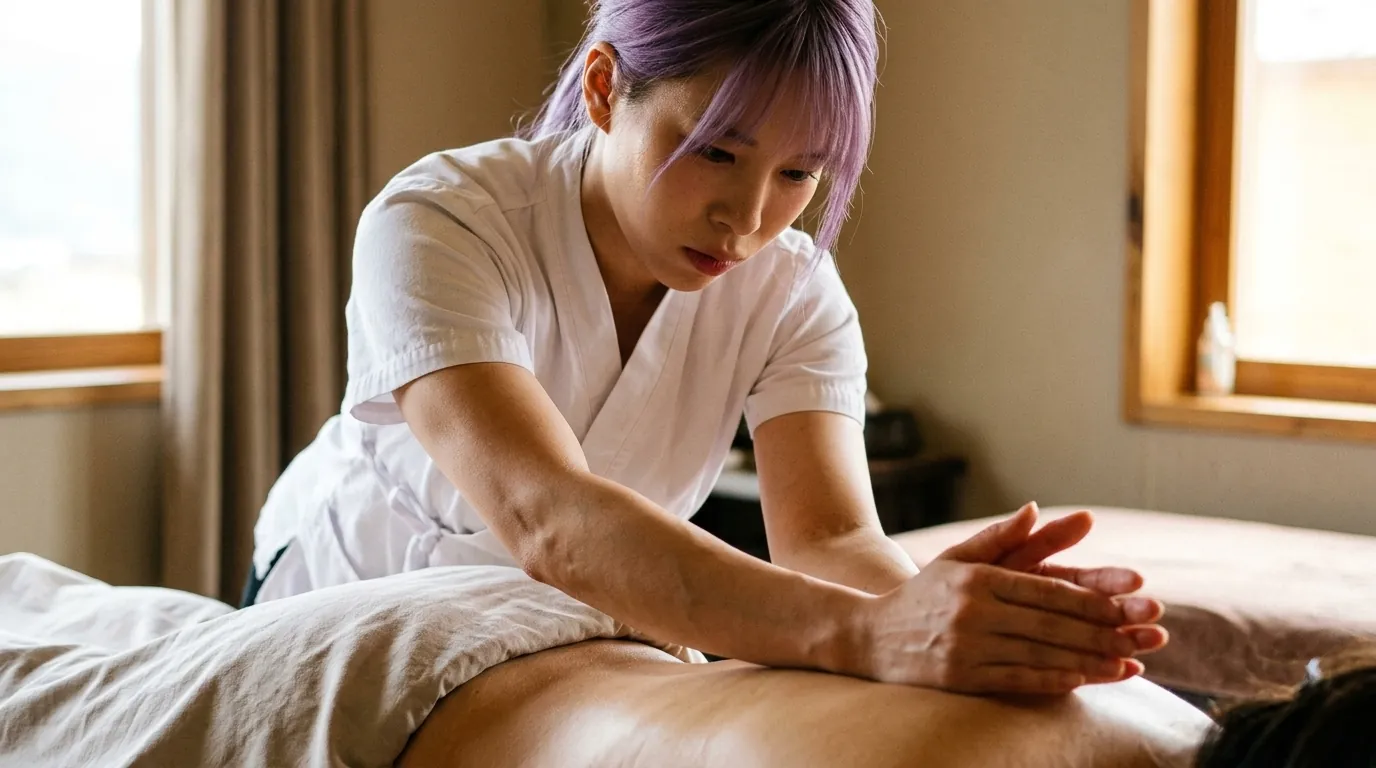
The opening minutes are broad and unhurried, working across large areas rather than digging into anything. Two things are happening at once: your body is settling, and the practitioner is reading what they are working with. By the time they have gone over your back and shoulders once, they generally know a good deal about where the tight areas actually are, which is often not where people said they would be.
This is the natural moment to say whether the pressure is right. "A little firmer" or "that is plenty" is enough. It is taken as information rather than complaint, and it is far better said at minute five than swallowed for an hour. A Swedish massage usually stays in this gentler register throughout, while a Thai Combination Massage will move you into stretches as well, so the opening tells you less about the whole session there.
What the middle of the session feels like
Somewhere around fifteen or twenty minutes in, most people stop monitoring the experience. The internal commentary quietens, you lose track of which part of your body is being worked on, and the hour starts behaving oddly: long while you are in it, very short when you look back.
A few practical things happen in this stretch. You will be asked to turn over at some point, and you will be told how, with the sheet held so you stay covered. Your head sits in a padded cradle when you are face down, which feels odd for about thirty seconds. You may be asked to move an arm or let a leg go heavy, and the only thing being asked is that you stay loose rather than help.
You may fall asleep. You may find your mind will not stop for the first twenty minutes and then suddenly does. You may notice one area feeling significantly more tender than the rest, which is common and worth mentioning rather than enduring in silence. None of these are signs you are doing it wrong. There is no version of lying still that counts as doing it wrong.
- Breathing out slowly when a firm area is being worked does more than anything else you could try.
- Cold feet, an itch, a cushion in the wrong place: all fixable in four seconds if you say so.
- Wanting less talking, or more, is a request like any other.
How do you know the massage has ended?
The ending is signalled before it arrives. The work broadens out again, slows, and finishes with something gentle rather than something intense. Then you are told plainly that the time is up, usually along with a quiet suggestion to take your time getting up. The practitioner then leaves the room and closes the door behind them.
Take the offer of time seriously. People often feel briefly light-headed if they stand straight up after lying still for an hour, so the habit worth copying is to roll onto your side first, sit on the edge of the table for a moment, and only then stand. You get dressed alone and come out when you are ready. There is no bell and nobody is waiting on the other side of the door.
The end of a massage is not the end of the appointment. What you do with the next half hour decides how much of it you keep.
The Massage & Spa Club
What does a first massage leave you with the next day?
Two things are common the morning after a first massage. Some people feel mildly tender in whichever areas had the most attention, in the way an unfamiliar bit of exercise leaves you aware of a muscle you had not thought about for years. Others feel nothing in particular except rested. Neither one means the session was pitched wrongly.
If the tenderness is more than you wanted, that is the one thing worth saying at your next booking, because it tells a practitioner exactly where to set the pressure without any guesswork. The hour straight after a massage also matters more than most first-timers expect, and planning the day around your massage covers what to do with it.
The thing nobody tells first-timers is that the first session is partly a research trip. You come out knowing whether you wanted more pressure or less, whether sixty minutes was enough, whether you would rather be stretched than stroked. That is useful information and it only exists afterwards. Book the one that sounds most like what you need today, and when you are ready, choose a treatment and a length with the rest in mind.
Common questions
Does a first massage appointment take longer than the massage itself?
The time on the table is the time you booked, but a first visit has a short conversation in front of it that later visits do not. That exchange is where the session gets planned, so it is worth arriving with room for it rather than treating it as an overrun. After the first visit the same conversation shrinks to a sentence or two.
Will the practitioner tell me what to do?
Yes, at every point where it matters. You will be told where to put your clothes, which way to lie, when to turn over and how. Nothing is assumed to be obvious on a first visit, and there is no stage where you are expected to work out the next step by yourself.
Is it normal to feel awkward at the start?
Yes, and it is almost always gone by the time the practitioner has worked across your shoulders. The awkward part is the unfamiliar sequence rather than the massage itself. Second visits feel completely different because you already know the shape of the hour.
What if I do not enjoy it once it has started?
Say so. Pressure, pace, position and which areas get worked on can all be changed in the middle of a session without anything being started again. If you would rather stop altogether, that is allowed too, and it is treated as information rather than as a problem.
Can I ask the practitioner to avoid a part of my body?
Yes, and you do not have to explain why. Say it at the start, name the area plainly, and it will simply be left out of the plan. This applies to anywhere you feel ticklish, sensitive, self-conscious or sore.