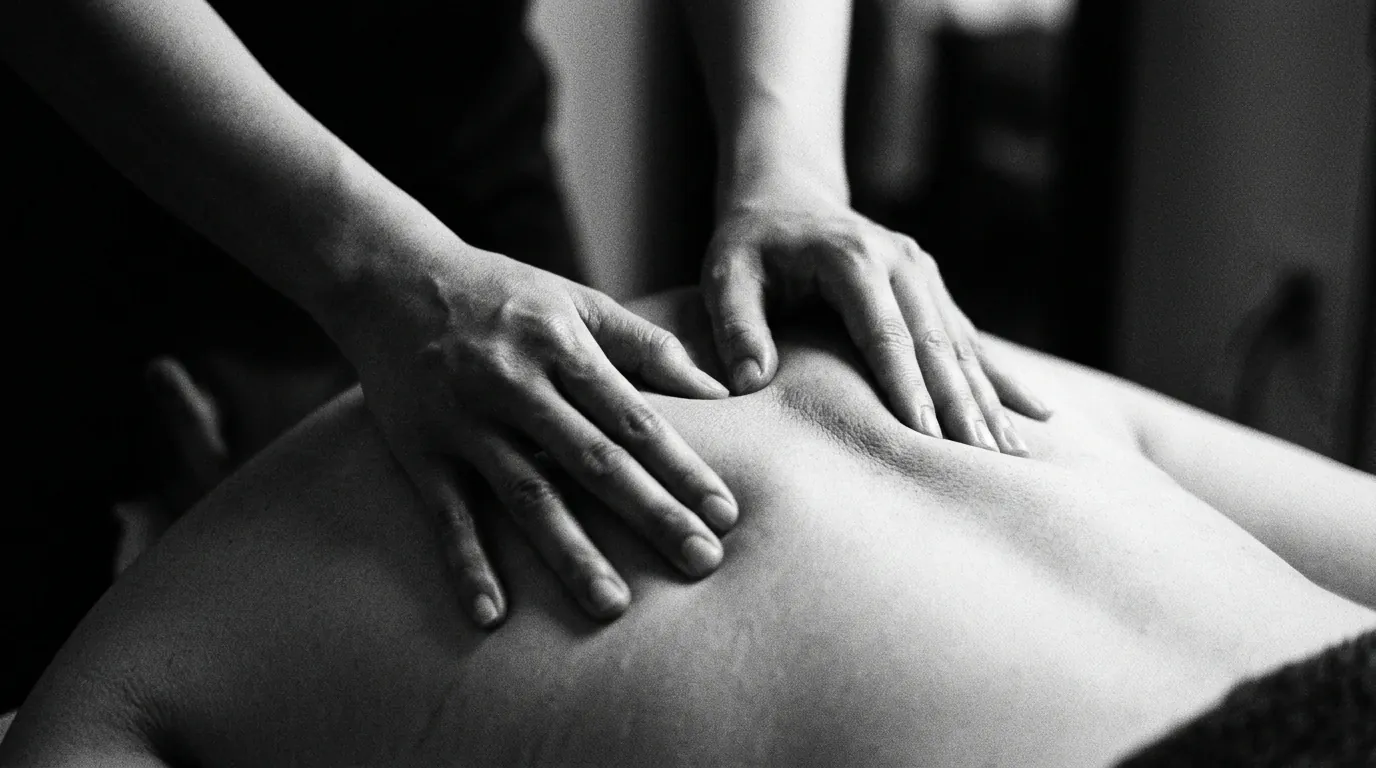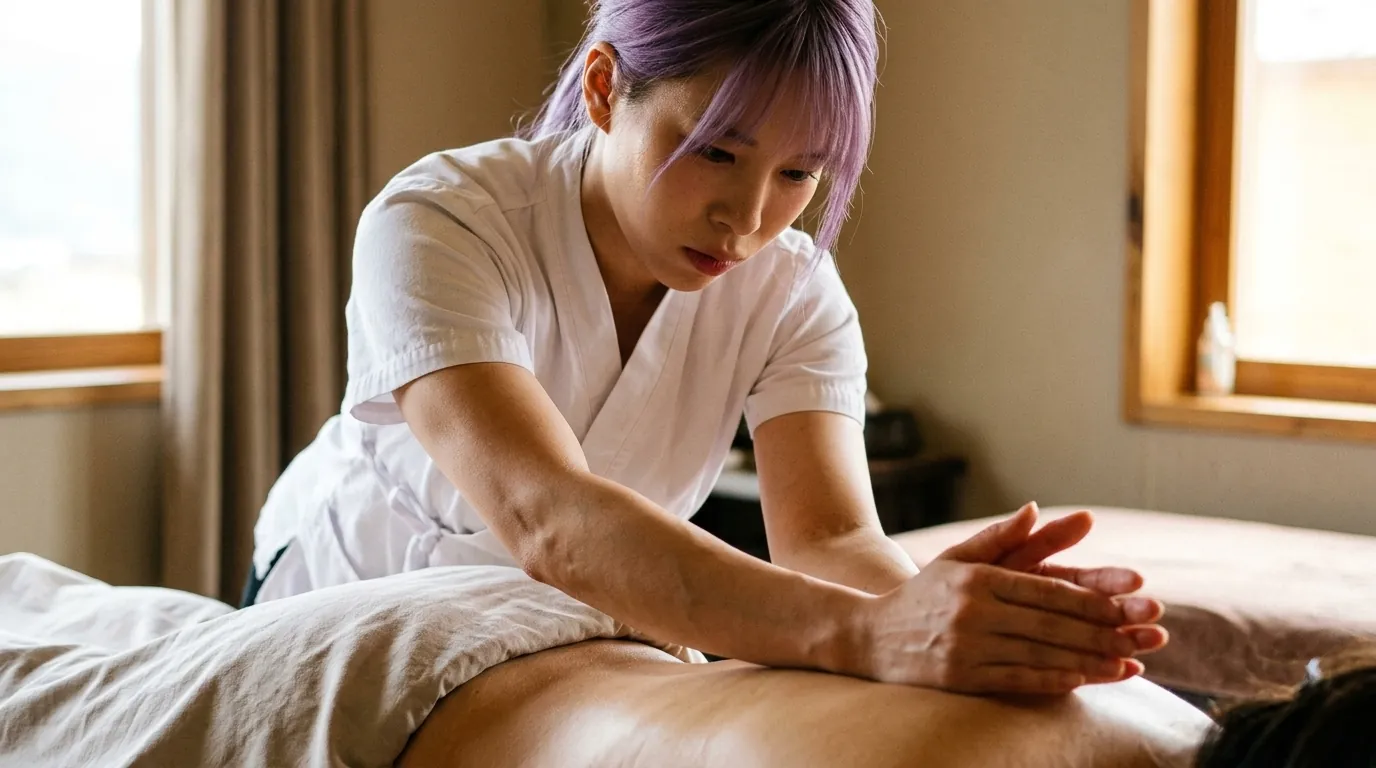
You can spend eleven hours doing almost nothing and still arrive feeling like you have been working. A journey asks very little of the body and leaves it flat anyway, and most people want the same thing at the other end, which is to stop being a passenger. Whether a massage gives you that depends less on the treatment you pick than on the day you put it.
Travel stiffness usually comes from hours held still in one shape, and for most people it eases over the following day or two. A massage after a long flight is less a repair than a full stop. Book gentle full-body work rather than deep pressure, and choose the arrival evening if sleep is the priority, the next morning if the day ahead is.
Why does travelling leave you so stiff?
A travel day compresses several small things the body dislikes into a single stretch of hours. None of them would register on their own. Together they add up to the particular flatness you feel in the arrivals hall.
- A fixed seat that decides your posture for you. Your hips, knees and spine hold roughly one angle for hours, and the small shifts you would normally make without noticing are not available.
- A headrest built for an average head. Most people end up with their neck slightly forward or slightly tipped, which is fine for ten minutes and tiring for ten hours.
- A bag carried on one side. The walk through the terminal is the most asymmetric thing many people do all month.
- Dry cabin air and not much water, which tends to leave you feeling wrung out before anything has touched your muscles.
- Sleep in the wrong places and at the wrong times, if there was any sleep at all.
The useful thing about that list is what is missing from it. Nothing there is an injury. Travel stiffness is short-term and spread across everything, which is quite different from the tension that builds up over months at a desk. That one is local, stubborn and comes back. This one arrives all at once and usually fades on its own.
The distinction matters when you book, because the treatment that suits a chronic shoulder is not the treatment that suits a body that has simply been folded up since yesterday. If your neck and shoulders are difficult in normal weeks too, everyday desk tension is the article to read alongside this one.
Should you book on arrival day or the day after?
This is the question travellers actually ask, and it is a scheduling trade-off rather than a right answer. Both days work. They simply buy different things.
| Arrival day | The day after | |
|---|---|---|
| What it gives you | A clean line between the journey and the trip. The day ends somewhere other than a suitcase. | A body that has slept once and moved a little, so the massage meets you further along. |
| How you tend to feel | Tired, a bit vague, grateful for a room where nothing is required of you. | More present, more able to say what you want and notice what is happening. |
| The risk | You may drift off, or find you have little appetite for conversation or pressure. | You may already have plans by then, and the stiffness may have half gone on its own. |
| Best if | You are aiming for an early night and want help stopping. | You want to be loose and clear-headed for a first full day. |
One practical note on the arrival-day option. Leave a gap between landing and the appointment if you can. Eat something, drink water, put the bag down. Arriving straight from a taxi with your luggage in the hallway is possible, but you spend the first part of the session still travelling.
Which massage suits a body fresh off a journey?
Lean gentler than you normally would. Travel leaves most people tired rather than knotted, and a tired body reads firm pressure as more work. There is also the dryness and the missing sleep, both of which make strong work feel like a lot.
Swedish massage is the natural fit. Long, flowing, full-body, nothing asked of you, and it covers all the places a seat has pressed against rather than concentrating on one. If you want to be asleep by ten, this is the booking.
Thai Combination massage suits the opposite instinct. After hours of holding one shape, some people want to be opened out rather than soothed, and assisted stretching answers that directly. It tends to leave you alert rather than sleepy, which makes it a better morning-after choice than a late-evening one.
4 Hands massage earns its place when the trip is short. Two practitioners working together cover ground quickly, so a single session reaches more of you than it otherwise would. It is also difficult to keep thinking about connections and emails while it is happening, which on a travel day is most of the point.
On length, a travel booking is one of the clearer cases for the longer session, because the first stretch is spent arriving properly and you want the good part afterwards. That trade-off is covered in full in choosing between sixty and ninety minutes.
What should you tell your practitioner?
Say that you have just travelled, and say how long for. It changes how the session is planned more than most things you could mention.
- Name the journeyTwelve hours in a seat, an overnight coach, three days of driving. The shape of the journey tells your practitioner where you have been held still.
- Point at the two worst placesUsually the neck and one shoulder, or the lower back and hips. Two is enough. A long list on a tired day only spreads the time thin.
- Say which way you are headingStraight to sleep, or out for the evening. A session can be paced towards either, and your practitioner cannot guess which you want.
- Ask for less before you ask for moreStart a notch gentler than usual and adjust upwards if it feels right. Going the other way is harder once a session has settled into a rhythm.
Does it help with jet lag?
Not in the sense of resetting anything. Your body clock changes at its own pace and a massage has no say in it. What an evening appointment does offer is a firm end to the day at a time when you would otherwise be lying down looking at a phone, wide awake, in the wrong time zone.
An hour with no screens, no decisions and no luggage in sight is a reasonable way to stop a travel day from continuing indefinitely, and the notes on an evening wind-down routine carry on from there.
When should you leave it a day?
Some travel stiffness is not the ordinary kind. If you have swelling in a leg, pain that is sharp rather than dull, a fever, or anything that feels different from tired, a spa is not the place to work out what is happening. Speak to a doctor first. The same goes for pregnancy, a recent injury or any ongoing medical condition, whether or not travel is involved. Practitioners are not there to give medical advice, and a treatment is not a substitute for one.
Short of that, the only real reason to wait is that you are too tired to enjoy it. There is a point past which you would rather be horizontal in the dark than anywhere else, and it is fine to book the following morning instead. When you know which day you want, you can look through the treatments and choose from there.
The journey ends when you stop moving. Sometimes it takes an hour on a table for that to be true.
Common questions
How soon after landing can I have a massage?
There is no waiting period to observe. People book a few hours after landing and people book the following afternoon, and both work. The deciding factor is usually how much of you has arrived: if you are still hungry, unpacked and slightly disoriented, give yourself a couple of hours first.
Does a long drive or a coach journey count the same as a flight?
For the purposes of booking, yes, and a drive often leaves more of a mark on one side. The pedals, the mirror checks and the hand on the wheel mean a driver holds a slightly twisted shape for hours rather than a symmetrical one. Mention that you were driving rather than sitting as a passenger, because it changes where a practitioner starts.
Should I book firm pressure to get rid of travel stiffness faster?
Firm pressure is not a shortcut, and after a long journey it often lands harder than expected because you are running on short sleep. Gentler full-body work tends to suit a travel day better. You can always ask for more pressure in one area once the session has started.
Is it better to book before the flight or after?
Before suits a journey you are dreading, because you board already unwound rather than carrying a packing week onto the plane. After suits a journey that has already happened. If you only book one, take the one on the side of the trip where you have more time to spare afterwards.
What if I am travelling with someone else?
Two people who have just spent a long day in transit together often want the same hour at the same time. A shared room suits that, and so does taking separate appointments back to back if you would rather have the quiet to yourself. Say which you want when you reserve.