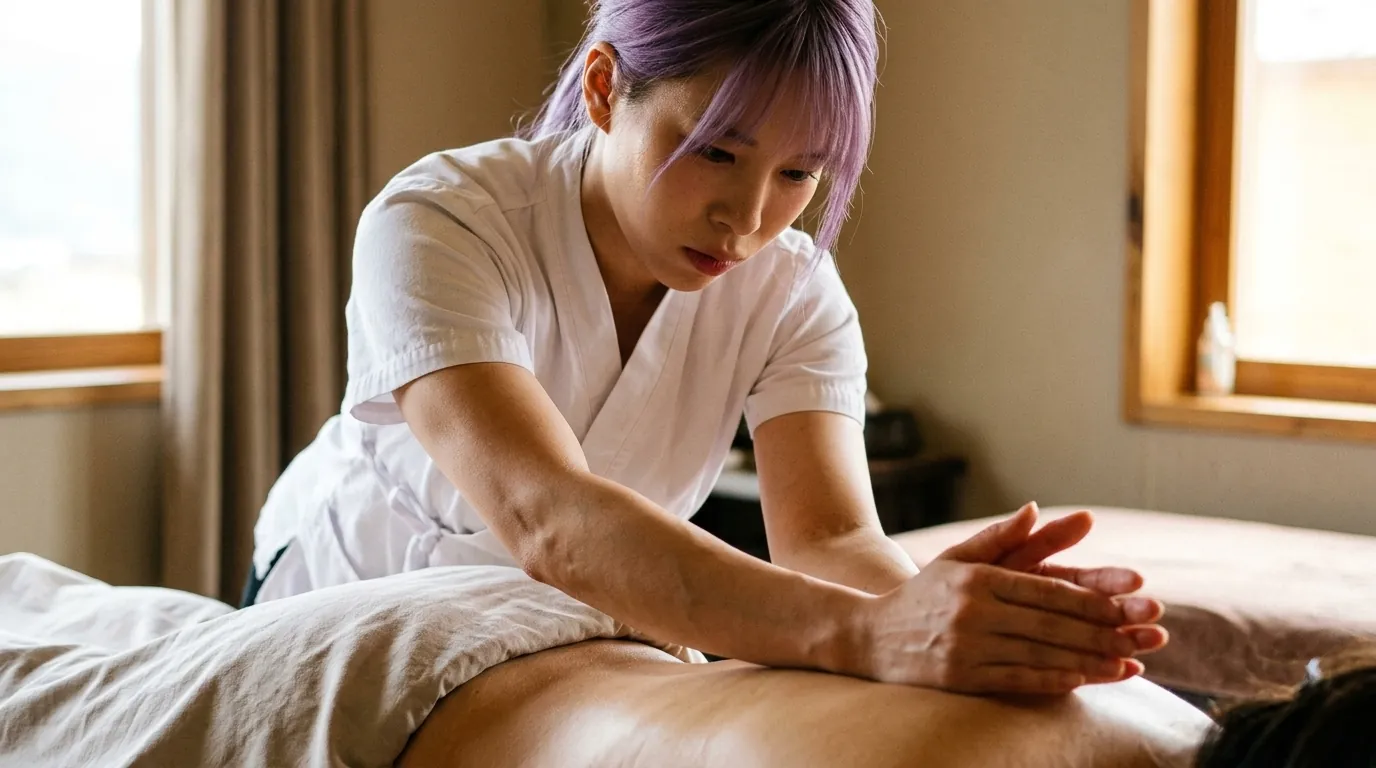
A desk day does not feel like effort while it is happening. You sit, you read, you type, you take a call. Nothing about it registers as work in the physical sense. Then you stand up at six and something across your shoulders has quietly set.
Desk work concentrates tension because holding a position is quiet, continuous work. Hours of it tend to settle in the same few places: the tops of the shoulders, the base of the neck, the strip between the shoulder blades and the forearms. Massage for desk workers usually means asking for time spent in that one region rather than spread evenly across the whole body.
Why does sitting still leave you sore?
Movement is not the only thing muscles do. Holding is also work. Keeping your head balanced over a screen, your arms reaching forward, your elbows away from your sides: none of that is heavy, but none of it stops either. A muscle that contracts and releases has a rhythm. A muscle that simply holds has no rhythm at all, and that is closer to what a desk asks for.
This is why the feeling is usually described as weight or gripping rather than as soreness. People say their shoulders feel high, or that there is a band across the top of the back, or that turning the head has fewer easy degrees in it than it did that morning. It tends to announce itself in the first hour after you stand up, which is often long after the day that caused it.
It is also why the same spots come back. Your desk gives your body the same instruction every day, and the body is good at following instructions.
Where does a desk day tend to land?
Ask ten people who work at a screen where they feel it and you will get a short, repetitive list. The geography of a desk day is remarkably consistent:
- The tops of the shoulders. The place hands go to first. Shoulders drift up towards the ears during concentration and rarely come back down without being told.
- The base of the neck and the back of the skull. Anyone who leans in towards small text knows this one.
- Between the shoulder blades. A narrow strip that is hard to reach yourself and easy to ignore until someone presses on it.
- The forearms and the backs of the hands. Typing and trackpad work are small, endless movements, and they add up in a way no single moment explains.
- The jaw. Not everyone, but more people than expect it, particularly on days with a lot of concentration or a lot of meetings.
- The hips and lower back. A chair keeps the front of the hips closed and asks nothing of the lower back for hours, which is its own kind of tiredness.
Almost all of that sits in the upper half of the body, in an area a practitioner can cover without moving very far. That is useful information when you book, because it means a session can be concentrated rather than distributed.
Do laptop days and monitor days feel different?
They do, and the difference is worth noticing because it tells you where to point the hour. What matters is where the screen sits and what is holding your arms up.
| Your setup | What your body has to do | Where you tend to feel it |
|---|---|---|
| Laptop flat on a desk | Look down, reach forward, hold the elbows away from the body | Neck, tops of the shoulders, forearms |
| Laptop on the sofa or in bed | Hold the head low and the arms up with nothing supporting either | Neck, upper back, shoulders, wrists |
| Monitor at eye height, arms supported | Much less holding, but the same position for hours | Between the shoulder blades, hips, lower back |
| Two screens side by side | Turn repeatedly to one side, often the same side all day | One shoulder and one side of the neck more than the other |
| Phone in the evening | Repeat the low-head position after work has finished | Neck and the base of the skull |
The two-screen row is the one that surprises people. Asymmetry tends to be felt as one shoulder that is simply worse than the other, with no event to explain it. If that is you, say so on the table. A practitioner will happily spend unequal time on the two sides once they know which side has been doing the turning.
Which treatment suits tension that sits in one place?
The useful question is not which massage is strongest. It is whether you want attention concentrated or spread out.
Deep tissue massage is built for concentration. It works slowly, stays in fewer places and gives the practitioner time to follow a single area rather than tour the whole body. If your answer to where it hurts is a specific patch you can point to, this is the shape of session that matches.
Swedish massage suits a different version of the same week. Some desk tension is not concentrated at all. It is a general wound-up feeling that came from a month of long days rather than from one bad afternoon, and what helps is a full-body session with flow to it rather than slow, local work. Swedish is also the better starting point if firm pressure is not something you enjoy.
Either can be adjusted. Pressure is a setting you choose and can change mid-session, which is covered properly in the guide to massage pressure rather than here. The choice between the two treatments is about the shape of the hour, not about how hard someone presses.
How do you ask for a session focused on your shoulders?
Most people describe the symptom and stop. Adding two sentences about the cause gives a practitioner far more to work with.
- Describe the day, not just the acheSaying you are at a laptop for eight hours and turn to a second screen on your left tells a practitioner more than tight shoulders does.
- Name the region and the prioritySay you would like most of the time spent on the upper back, shoulders and neck, and that you do not mind if the legs get five minutes or none.
- Say what you want it to feel likeSlow and firm in one place is a different request from broad and soothing. Both are reasonable. Neither is assumed.
- Flag the sensitive spotsThe neck and the base of the skull are areas many people want worked carefully or left alone. Say which you are, before rather than during.
- Adjust out loudIf the pressure is not right at minute fifteen, say so at minute fifteen. There is a fuller set of phrasings in telling your practitioner what you want.
What one session realistically changes
An hour of focused work tends to leave the area feeling looser and warmer, and people often describe turning their head as easier than it felt when they arrived. Some notice a little tenderness the next day where the work was slow and concentrated, which settles.
What a session does not do is change the input. Your desk will make the same request of you on Monday. This is not a failure of the massage. It is the honest arithmetic of a load that repeats, and it is the reason people who sit all day tend to settle into a rhythm of visits rather than treating massage as a one-off repair. What that rhythm looks like is its own question, answered in how often to book.
What helps between visits
None of this is treatment, and none of it requires equipment. It is simply the opposite of what a desk asks for.
- Change position more often than you change tasks. The best posture is mostly the next one.
- Give your forearms something to rest on. Unsupported arms are held arms.
- Raise the screen if you can, even onto books, so your eyes meet it rather than fall towards it.
- Move the second screen to the middle occasionally, or swap which side it sits on.
- Let your shoulders drop when you notice them up. Noticing is most of it.
- Give the evening a different shape from the day. An unhurried wind-down routine is worth more than another hour of scrolling in the same low-headed position.
Small changes make the sessions work better, and the sessions make the small changes easier to notice. When you are ready to book time that stays in one region, you can look through the treatment menu and choose the shape of hour that suits your week.
A desk asks the same thing of your shoulders every day. An hour spent answering it is not wasted because the question comes back.
Common questions
Is massage for desk workers different from a normal massage?
The techniques are the same. What changes is how the hour is spent. A session shaped around desk tension gives most of its time to the upper back, shoulders and neck, and treats the legs as a brief visit rather than a destination. You get that version by asking for it at the start, not by booking a differently named treatment.
Why do my shoulders feel tight when I have not lifted anything?
Effort and movement are not the same thing. Holding your arms forward towards a keyboard is a small load that never quite switches off, and a load that never switches off is felt differently from one that ends. People often describe it as a gripping or a weight rather than soreness, and notice it most in the first hour after they stand up.
Should I book a shorter session if I only want my shoulders done?
Not necessarily. A region does not need less time simply because it is smaller, and concentrated work tends to be slow by nature. A longer session is often the more useful booking, precisely because it lets the practitioner stay in one area without rushing. Both lengths are available on each treatment page.
Can a practitioner tell me what is wrong with my posture?
A practitioner can tell you what they notice under their hands and where you seem to be holding. That is an observation, not a diagnosis, and it is not medical advice. If something is painful, persistent or changing, that belongs with your doctor rather than with a massage table.
Does working from the sofa really make a difference?
It changes what your body has to do. A sofa puts the screen low and the arms unsupported, so the work of holding your head and elbows in place falls on you rather than on a chair and a desk. Many people notice their neck more after sofa days and their forearms more after desk days.