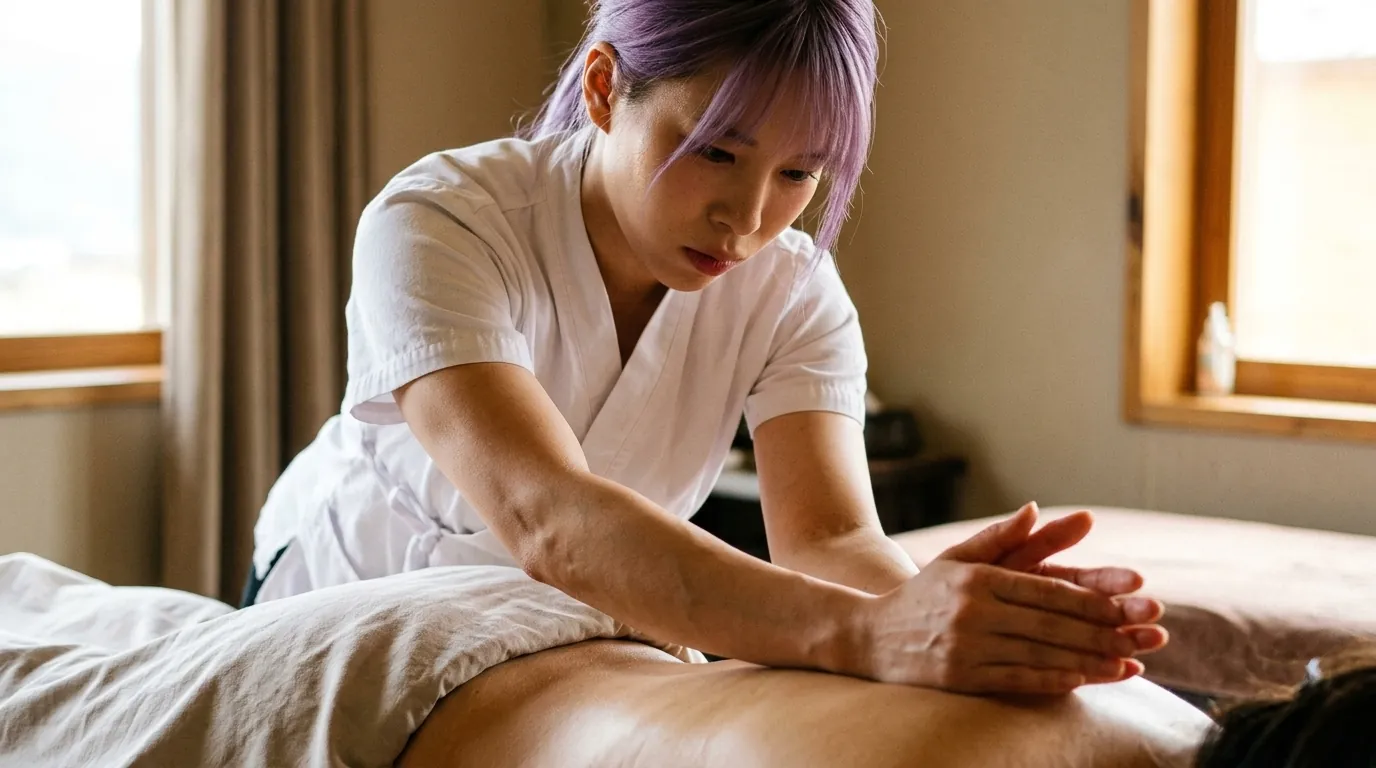
A spa hour works partly because of what is done to you and partly because of the order it is done in. The light drops before anything else happens. What is coming at you reduces one step at a time rather than all at once. You can borrow that order on an ordinary Tuesday at home, and it costs nothing.
An evening wind down routine works by copying the order a spa uses rather than its equipment. Choose a fixed point where the working day ends, lower the light earlier than feels necessary, and reduce what is coming in instead of adding something calming on top. Keep the same sequence most nights. The repetition does more than any single step in it.
Why does an hour at a spa feel different from an hour at home?
Very little of it is the treatment room itself. Most of it is that the hour is sequenced. You are moved from the street into a quieter space, then into a warmer one, then asked to lie down, and only then does anything begin. Each stage is a smaller version of the one after it, so the drop is gradual instead of sudden. By the time the work starts, most of the slowing has already happened.
An ordinary evening often has no sequence at all. Work ends when the laptop closes, and something else starts in the same minute, in the same chair, under the same overhead light. Nothing about the room tells you the day has changed shape. That is the gap worth closing, and it is a matter of arrangement rather than effort. A short article on why a treatment room feels the way it does covers the design side of this in more detail.
What is a transition point and why does it matter?
A transition point is one small physical thing that happens at the same moment every evening and means only one thing. At a spa it is handing over your shoes and your phone. At home it can be changing out of what you worked in, washing your face, putting the phone on a shelf in another room, or making a drink you only make at that hour.
It should be dull and it should be short. Anything that takes effort will not survive a hard week, and a routine that only works on easy evenings is not a routine. What gives it weight is repetition. After a fortnight the action starts arriving before the feeling does, which is the whole point of having one.
An evening does not need to be emptier. It needs to be in an order your body recognises.
Which four things actually change the feel of a room?
Not many, and none of them are expensive. A treatment room changes the same four, in roughly this order.
- Light, first and earliestTurn the overhead light off and leave two low lamps on, an hour before you think you need to. Light from above and behind the eye line reads as daytime. Light from low down and off to one side does not. This is the single change most people notice immediately.
- Sound, by subtractionTake something away before you add anything. Television with dialogue in it keeps part of your attention following a plot. If you want sound, choose something without words, and keep it quiet enough that you could hear the street through it.
- Warmth on the skinA room at a comfortable temperature still feels neutral. Something warm in contact with you does not: a heavy throw, warm socks, a hot drink held rather than drunk. A spa warms the table and the towels for this reason, and it is the cheapest part to copy.
- One clear surfaceNot the whole flat. One table or one corner of a worktop, cleared and left clear. A single tidy surface in an untidy room is enough to rest your eyes on, and clearing one small area is a job you will still do on a bad evening.
How do you reduce input instead of adding calm?
The common mistake is treating relaxation as another item to fit in. A candle is lit, a playlist goes on, a bath is run, and all of it lands on top of an evening that was already full. The evening gets busier and slower at the same time, and the result is a list of tasks with pleasant names.
The spa version works the other way. Almost everything is removed and very little is offered. No screens, no notifications, no decisions to make, no conversation you are obliged to hold up. What stays is a small number of things, done slowly. At home the equivalent is choosing what the last hour will not contain, then leaving the space where those things were rather than filling it.
Boredom is the usual objection, and it is fair. The first few evenings feel flat. That flatness is mostly the absence of the input you are used to, and it passes in about a week.
What does a plain evening sequence look like?
Four stages, none of them precious. Adjust the times to your own evening and keep the order.
- The last twenty minutes of work. Finish the thing you are on, write down the first task for tomorrow so you are not holding it, and close the laptop somewhere you will not see it again tonight.
- The transition. Your one fixed action, then the lights down and the overhead off. This takes five minutes and does most of the work.
- The hour after. Whatever you actually enjoy, kept slow and mostly wordless. Reading, cooking without a podcast on, a bath, sitting with someone without the television on behind you.
- The last half hour. Nothing new begins here. No fresh episode, no email opened, no conversation that needs deciding. The evening narrows rather than stops.
Where does a massage fit into a routine you do at home?
As the anchor, not the routine. A treatment happens occasionally, and what it gives you is an unusually clear example of how slow an hour can be. Most people leave a Swedish massage noticing how unhurried they have become, and that is a useful thing to have felt recently, because it gives the evening version something to aim at.
There is also a practical overlap. The evening of a treatment is one you want to keep quiet anyway, and the same lowering of light and input applies. What you do either side of a massage goes into that in more detail. If the evening is a shared one, a couple massage turns the anchor into something both of you did, which tends to make the quiet afterwards easier to keep.
How often to come back is a separate question, and the piece on massage frequency works through it properly. For this purpose, occasionally is enough. The routine is the part that runs every night.
What happens when the routine falls apart?
It will, and not much follows from that. Nothing accumulates across evenings and nothing is undone by a fortnight of late nights, deadlines or small children who have other plans. The order is what you return to, and it takes one evening to pick up again.
When the time is not there, shrink it rather than skip it. Ten minutes in the right order beats an hour in the wrong one. The transition point, the light down, and then whatever is left of the evening.
One note worth stating plainly: this is about the shape of an evening, not about health. If you are dealing with a medical condition, an injury, persistent pain or a pregnancy, speak to your doctor about it, and tell your practitioner before any treatment so the session can be adjusted. Nobody here is giving medical advice.
Build the evening first, since it runs every night and costs nothing. Then, when you want the anchor, choose a treatment and put it in the diary somewhere you will actually see it.
Common questions
How long should an evening wind-down routine be?
Shorter than you think, and the same length most nights. Twenty minutes kept every evening will settle into a habit faster than ninety minutes kept twice a week. Length is the part to cut when the week gets difficult. The order is the part to keep.
Does it matter what time I start?
The consistency matters more than the hour. A routine that begins at ten on weeknights and midnight at weekends is still a routine. What breaks it is starting at a different point in the evening each night, because then nothing you do becomes a signal that the day is finishing.
What if I live with other people?
Then build it around one small thing that is yours rather than around the whole flat. A shared home rarely allows a whole quiet hour. It usually allows one lamp, one chair and ten minutes that everybody knows about. Saying out loud that this is your wind-down is part of what protects it.
Is a bath, a candle or a playlist worth adding?
Only if it replaces something rather than sits on top of it. Most evenings are already full, so an added ritual becomes one more task to complete. A bath that takes the place of a second hour of scrolling is doing real work. A candle lit while you keep scrolling is decoration.