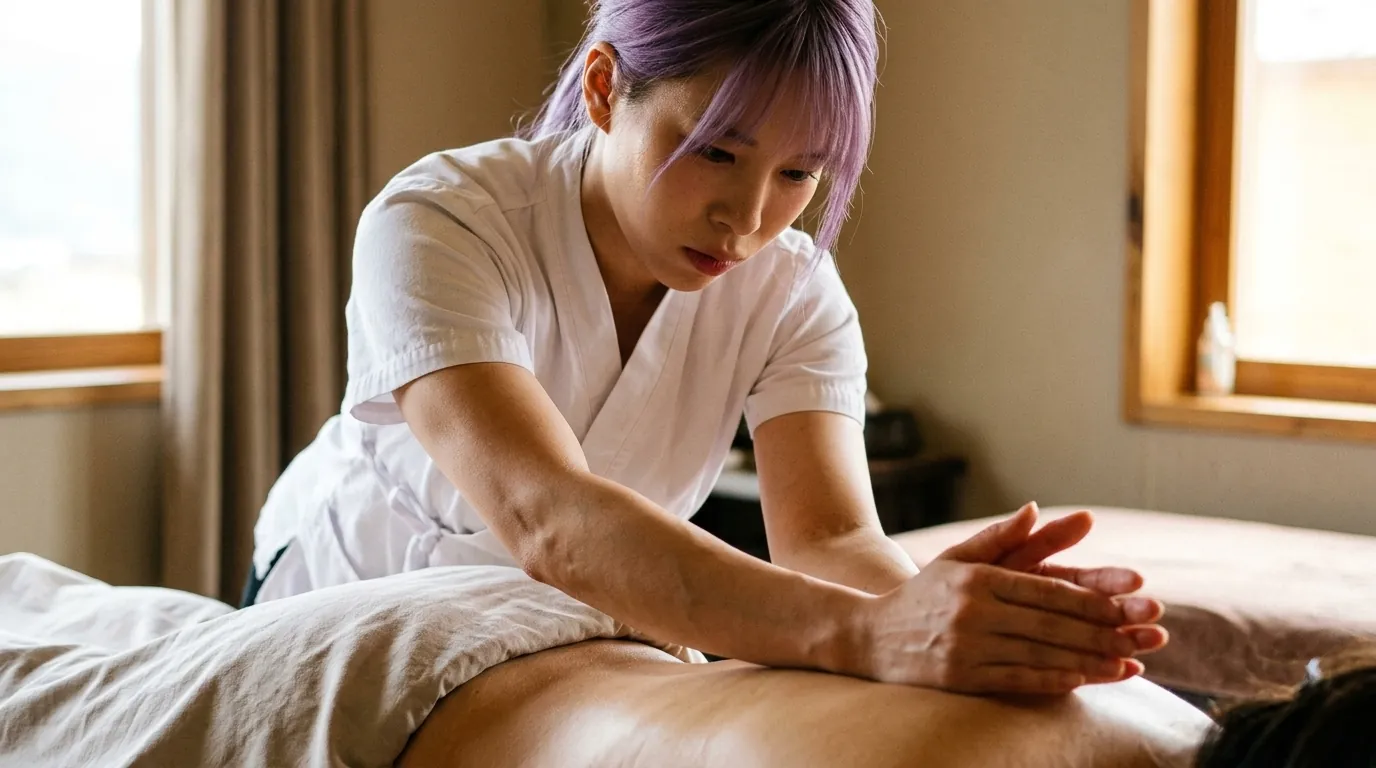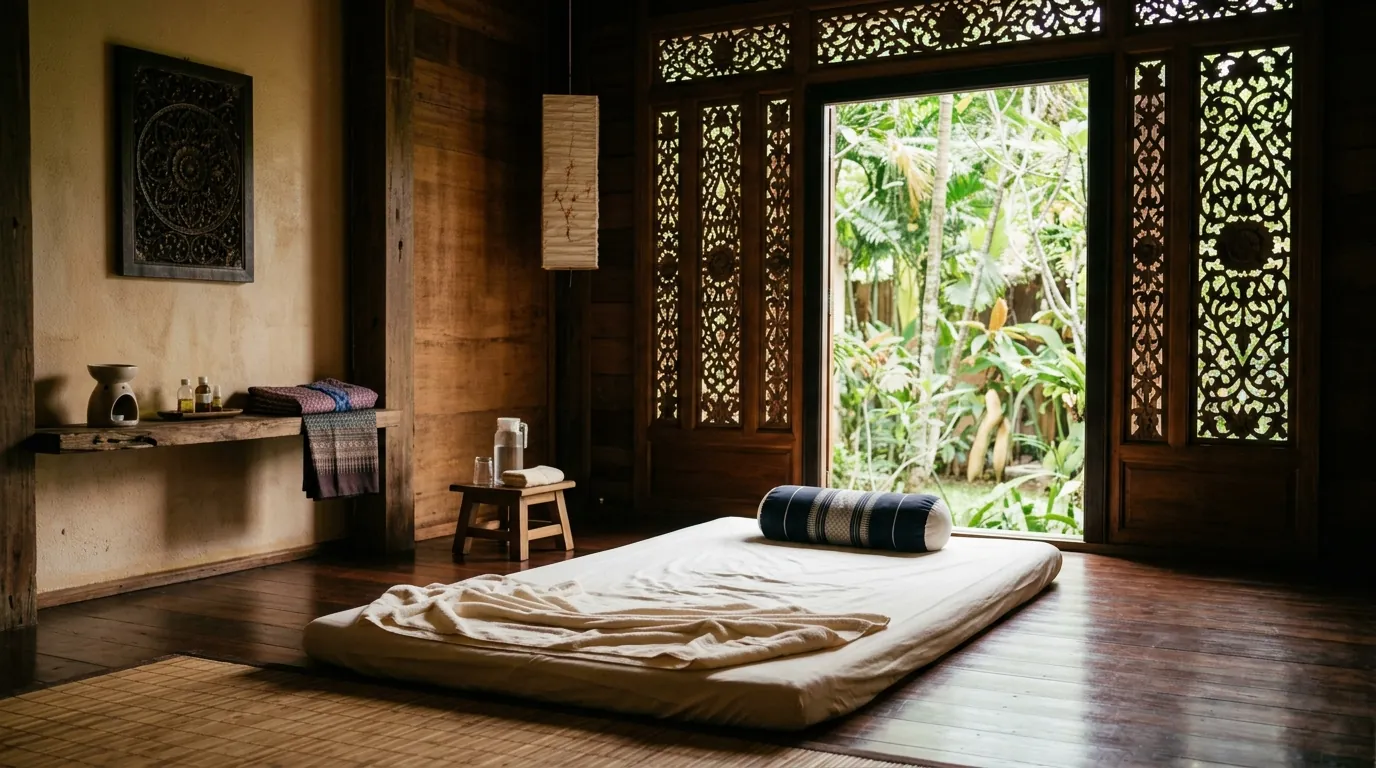
A treatment room is a piece of design you are not supposed to notice. If you do notice it, something has gone slightly wrong. Nearly everything that makes the room feel the way it does was decided before you arrived, and most of it is subtraction rather than decoration.
A spa room feels calm because almost every surface, sound and light source has been chosen to give your attention nothing to catch on. The light sits low and indirect rather than overhead, the room is kept warmer than a living room, the sound carries no words or story, and soft surfaces absorb noise instead of bouncing it back at you.
Why is the light never overhead?
Overhead light is made for seeing. It is efficient, it is even, and it points straight down at a person lying on their back. Face up on a table, you meet it as a bright wash through closed eyelids. You can feel a ceiling light without ever opening your eyes, and some part of you keeps track of it.
So the light gets moved sideways and downwards. A shaded lamp at low level. Light bounced off a wall rather than thrown across the room. A single warm source in a corner instead of four cool ones in a grid. The room ends up dimmer than any room you would read in, which is the whole intention: reading light keeps the eyes working, and eyes that are still working keep the rest of you mildly on duty.
Why is a treatment room kept warmer than a living room?
Because you are about to stop moving. A body lying still under a sheet generates far less warmth than the same body walking around a house, and the temperature that feels pleasant while you are upright and dressed can feel noticeably cool twenty minutes into lying down.
There is a practical reason to care. A person who is slightly cold holds on. The shoulders lift, the jaw sets, the hands stay closed, and no amount of skilled work talks a cold body into letting go. Warmth does that part before the treatment even begins.
You will usually meet the same idea in three forms at once: the room itself a few degrees above what you would choose at home, linen that has been warmed rather than taken cold from a shelf, and the habit of uncovering only the area being worked on and covering it again afterwards. That last one is comfort and privacy in a single movement, and it is a good part of what people mean when they say a first massage felt less exposing than they feared.
Why does spa music never have words?
A sung line is a small task. Language arrives and something in you starts following it, guessing the next phrase, deciding whether you agree with it. That is a quiet kind of work, and you do not get to opt out of it just because you would rather be resting.
Structure matters as much as lyrics. A track that builds towards something takes you with it, and an hour of small arrivals and departures is not an hour of rest. What gets chosen instead tends to be slow and more or less directionless, music going nowhere on purpose. If you cannot remember afterwards what was playing, it was the right choice.
Sound has a second job in a spa, which is covering other sound. A low continuous layer smooths over a door closing along the corridor or a conversation two rooms away. Without it, every ordinary noise in the building arrives as a separate event.
Why does a calm room sound soft as well as quiet?
This is the detail almost nobody consciously registers, and it does more than the lighting does. Hard glossy surfaces reflect sound. In a room of tile, glass and bare plaster, a bottle set down on a shelf is a sharp little crack that comes back at you off three walls. The room is technically quiet and still feels brittle.
Layered fabric does the opposite. Curtains, a rug over a hard floor, heavy linen, upholstered surfaces, a covered table. Each of them shortens the time a sound takes to die away, and the effect on a listener is immediate even though the cause is invisible. You walk in and describe it as soft, or cocooning, or hushed, and what you are actually responding to is the absence of an echo.
It is also why a practitioner's own habits count as part of the room. Bottles set down rather than placed, feet planted rather than shuffled. In a soft room those things nearly vanish. In a hard one they punctuate the hour.
Why is the scent kept so low?
Strong fragrance is an event, and an event is what a treatment room is trying not to contain. A smell you love is still something you keep noticing. A smell you dislike is close to unbearable for an hour with your face resting in a cradle a few inches above it. So the aim is usually something warm and close to neutral, present enough that the room does not smell of nothing at all and faint enough that you stop registering it within a few minutes. The same restraint applies to what goes on your skin, which is why the choice between oil and balm is settled on feel and glide rather than on perfume.
What is the room deliberately missing?
As much as what it contains. The absences are chosen, and they are consistent enough across good rooms that they start to look like a shared rulebook.
- No clock in your eyeline. Time you can check is time you start managing.
- No screen, and nothing that asks for a response. Anything that could light up or buzz is a thing you are half waiting for.
- No mirror facing the table. Rooms for being looked at and rooms for being unobserved are different rooms.
- Very little on the walls. A picture with a subject in it is something to think about.
- Nothing sharp underfoot on the way in. The floor you walk to the table on is usually warm, soft or both.
- The corridorThe walk from the door to the room is deliberately unhurried and usually dimmer than the entrance. Pace is contagious. Someone walking slowly in front of you slows you down without saying anything about it.
- The handoverQuestions are asked while you are still upright and dressed, because it is far easier to say what you want before you are lying face down. Once the treatment starts, the talking is meant to stop being necessary.
- The minute aloneYou are left to undress to your comfort and settle under the sheet by yourself. That short private gap is doing real work. It is the point where the room stops being somewhere you have entered and becomes somewhere you are.
Does any of this change when there are two of you in the room?
The principles hold, but the geometry changes. A room set up for Couple Massage has to work for two people who may want completely different things from the hour, so the tables sit with a little distance and the light is placed so that neither person lies in the glow of the other's lamp. Sound often sits slightly higher than it would in a single room, which gives each of you the option of talking quietly, or of saying nothing, without either choice feeling conspicuous.
A room for 4 Hands Massage has the opposite problem. One guest, two practitioners, and both sides of the table in use throughout. That needs real clearance to move around and a shared choreography quiet enough that the work never stops feeling like one pair of hands. When two practitioners are moving well together you hear almost nothing from either of them, and that silence is rehearsed rather than accidental.
Care is mostly small decisions, made early, that nobody is meant to notice.
The one thing worth taking from all of this is that none of it is fixed. The light, the warmth, the sound and the amount of conversation are all adjustable, and adjusting them is an ordinary part of the hour rather than an imposition. Whichever treatment you choose from the collection, the room is doing the same quiet work underneath it, and it will do that work better if you say what you actually want from it.
Common questions
Can I ask for the music to be turned off?
Yes, and more people do than you would think. Silence suits some guests better than any soundtrack, particularly if you are sensitive to sound or simply prefer your own quiet. Say so at the start rather than partway through, so your practitioner is not reaching for a dial while their hands are busy.
Can I ask for the room to be warmer or cooler?
Always. Comfort with temperature is personal and nobody can guess yours from the outside. A room that suits one guest can feel close to another, and the fix is usually a small one: a blanket added, a layer taken away, the air adjusted. Speaking up early costs you a few seconds and saves you an hour of being slightly wrong.
Why do treatment rooms have so little in them?
Because anything in the room is something your eye can land on and your mind can start working through. A room with very little in it gives attention nowhere in particular to go. The restraint is the point rather than a sign of an unfinished space.
Is it normal to fall asleep during a treatment?
It is very common and nothing to apologise for. Warmth, low light, steady repetitive contact and nothing asking for a response is a combination that settles a lot of people completely. Your practitioner carries on either way, and if you wake up unsure how long you were gone, that is usually taken as a good sign.