Most massages have a shape you can follow. One practitioner works down one side of the body, moves to the other, and some quiet part of your mind keeps track of where the hands will go next. A 4 hands massage takes that map away from you.
A 4 hands massage is a treatment where two practitioners work on one guest at the same time, coordinating their movements so the session feels like a single continuous rhythm rather than two separate massages. They may mirror each other, working the same stroke on both sides, or alternate, so one pair of hands is always moving. Most people describe it as immersive and hard to track.
What actually happens in a four hands massage?
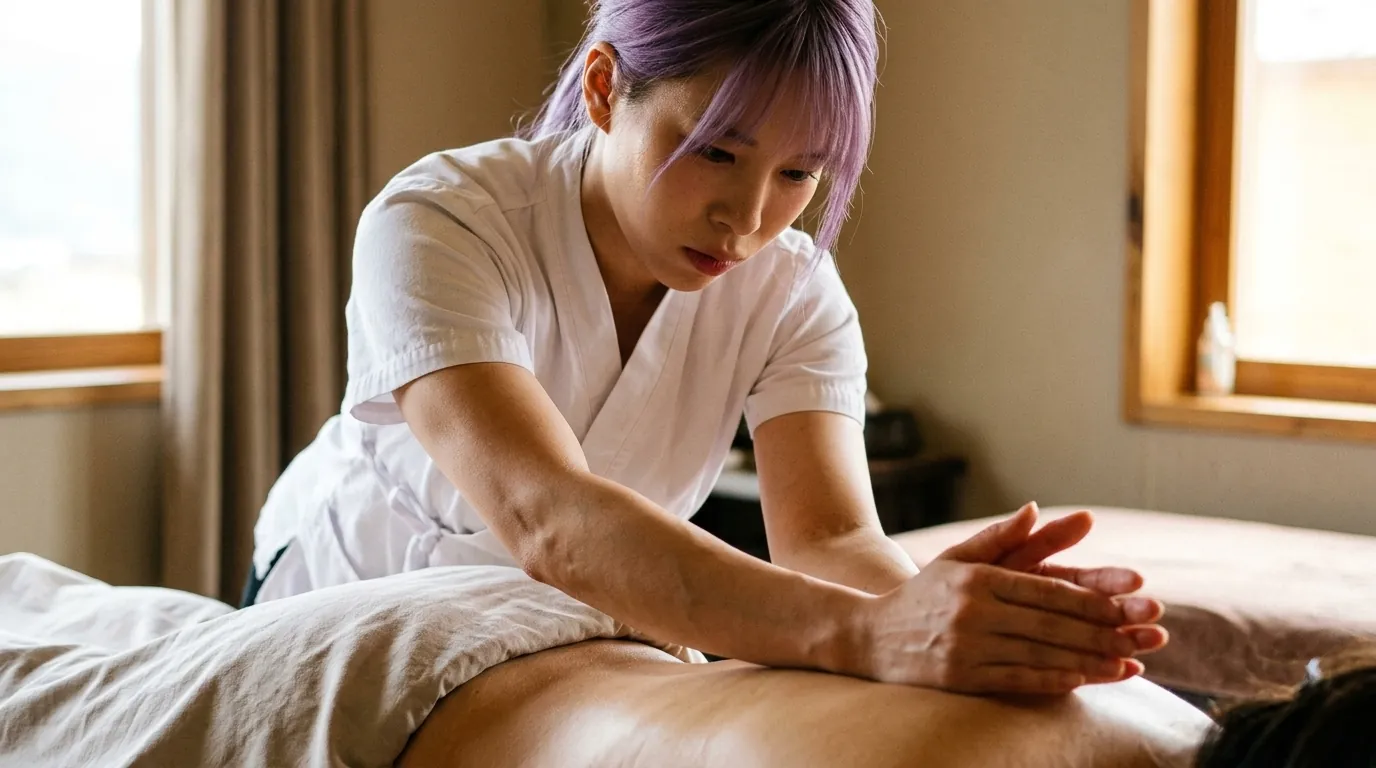
Two practitioners stand on either side of the table and work on you together for the length of the session. It is one treatment, not two people taking turns, and it is not two massages happening near each other. The techniques are the ones you would recognise from an oil massage: long strokes, kneading, steady pressure held in one place. What changes is that they arrive from two directions at once.
Because there are four hands, more of the body is covered in the same amount of time. A single practitioner working a full body session has to move through it in sequence. Two practitioners can hold a shoulder and a calf at the same moment, which is a sensation that simply has no equivalent in a one practitioner treatment.
Not everything divides in two. The head, the face, the neck and the scalp are single practitioner work, because two people cannot share them without the touch turning clumsy. At those moments one practitioner steps back, or moves down to a foot and holds it while the other works. The contact does not stop, but it becomes uneven on purpose, and that unevenness is part of the design rather than a gap in it.
The turn is the other moment worth knowing about. When you move from lying face down to face up, one practitioner lifts and resets the covering while the other steadies the table side, so the change takes a few seconds and you are not left lying there waiting. Good four hands work is often judged on how little you notice these joins.
Mirrored or alternating: the two ways four hands move
Coordination is the whole craft here, and it generally takes one of two forms. In mirrored work, both practitioners perform the same movement at the same time on opposite sides of the body, so a stroke up the left calf is matched exactly on the right. In alternating work, the two sides deliberately fall out of step, so one pair of hands is finishing a stroke while the other begins.
A good session moves between the two. Mirroring feels balanced and symmetrical, and it tends to be used to settle you at the beginning and to close the treatment. Alternating feels continuous, because contact with the body never fully breaks.
In most sessions one practitioner leads and the other follows. The lead sets the pace, starts each new sequence and decides when to change pattern, and the second picks it up within a stroke or two. You are not meant to be able to tell which is which, and by the middle of the session you usually cannot.
| Mirrored | Alternating | |
|---|---|---|
| How it moves | The same stroke on both sides at the same moment | One side leads, the other follows a beat behind |
| How it commonly feels | Even and symmetrical, like being held in balance | Continuous, with no gap between strokes |
| Often used for | Opening and closing the session | The long middle stretch of the treatment |
| Effect on attention | Easy to follow at first, then it blurs | Very difficult to follow at all |
Why you stop being able to predict the next stroke
There is something the mind does during an ordinary massage that most people never notice until it is taken away. You anticipate. You feel a stroke finish at the shoulder blade and you know, without deciding to know, that the next one starts at the lower back. That small act of prediction keeps a part of you slightly outside the experience, watching it.
With four hands the prediction fails. There are too many points of contact and they do not follow a single sequence. After a few minutes the trying tends to stop. That giving up is not a side effect of the treatment. It is the reason the treatment exists.
When there is nothing left to follow, there is nothing left to do but be here.
How does it feel compared with a single practitioner?
Fuller, and faster to arrive somewhere. People often say a four hands session feels shorter than it was, which is usually a sign that the tracking stopped early. It is also busier. If you value the slow, deliberate pace of one pair of hands working through an area at a time, a Swedish massage gives you that instead, and there is no shame in preferring it.
Pressure works differently too. More of the body is receiving attention at once, so the same firmness feels like more. If you already know what pressure suits you, say so at the start and know that it will read a little stronger than usual. The guide to massage pressure covers how to describe what you want.
Is a four hands massage the same as a couple massage?
No, and the two are confused constantly. A couple massage is two guests with a practitioner each, side by side. A four hands massage is one guest with two practitioners. If you are weighing them up, the comparison between them sets out which suits which occasion.
Who tends to enjoy it, and who does not
It suits people who already know they like massage and want something less ordinary, and people who find it hard to switch off because their attention keeps working. It suits a session you have set aside as genuinely yours rather than one squeezed between two other things.
It suits some people less well. If you are new to massage, one practitioner is the easier place to learn what you like, and what to expect at a first massage is the better starting point. If you have one specific area you want worked on slowly and thoroughly, a focused single practitioner treatment will serve you better than four hands spread across the body.
How to get the most out of the session
- Decide the shape before it startsWith two practitioners the plan matters more. Say whether you want the whole body evenly covered or more time on the back and shoulders, so they can divide the work before the first stroke.
- Set your pressure once, clearlyGive one instruction that applies to both sets of hands rather than correcting each side separately during the treatment. Remember that four hands read firmer than two.
- Let the tracking goTrying to follow where each hand is will keep you alert for the whole session. It is easier to let attention rest on the breath, or on nothing in particular.
- Leave time at the endThe first minutes afterwards tend to feel slower than usual. Do not schedule something urgent immediately after.
How long should a four hands session be?
A longer session gives the practitioners room to slow the pace through the middle, which is where four hands work is at its most distinctive, and the wider question of length is covered in choosing between a shorter and a longer session. The treatment is available in more than one length, and you can see what it currently runs to when you look through the menu.
Common questions
Is a 4 hands massage twice as strong as a normal massage?
Not in the way people expect. Two practitioners cover more of the body at once, so more of you is being worked on at any given moment, but the pressure on any one area is set the same way it always is, by what you ask for. You can ask for a lighter touch and still have all four hands on you.
Do the two practitioners talk to each other during the session?
Very little, and usually not in a way you notice. The timing is carried by the strokes themselves rather than by conversation. If something needs adjusting they will speak to you rather than over you.
Can I ask for one area to get more attention?
Yes, and it is worth saying so at the start. With two practitioners the plan for the session matters more than usual, because they are dividing the body between them. Ask before the massage begins rather than halfway through, so the choreography is built around what you want.
Is a 4 hands massage suitable if I have never had a massage before?
It can be, although many people prefer to start with one pair of hands so they learn what they like. If it is your first treatment and you are unsure, a gentler single practitioner session is an easier place to begin, and a four hands session will still be there afterwards.
Do I need to do anything differently during the massage?
No. You lie still and let the session happen, the same as any other treatment. The one thing worth trying is to stop tracking where the hands are going, because following two practitioners at once is tiring and the session works better when you give up on it.