A couple massage is the one treatment where the interesting question is not about technique. It is about the room. Two people, one space, two sets of hands, and a lot of small practical details that nobody explains until you are already lying down. So here they are first.
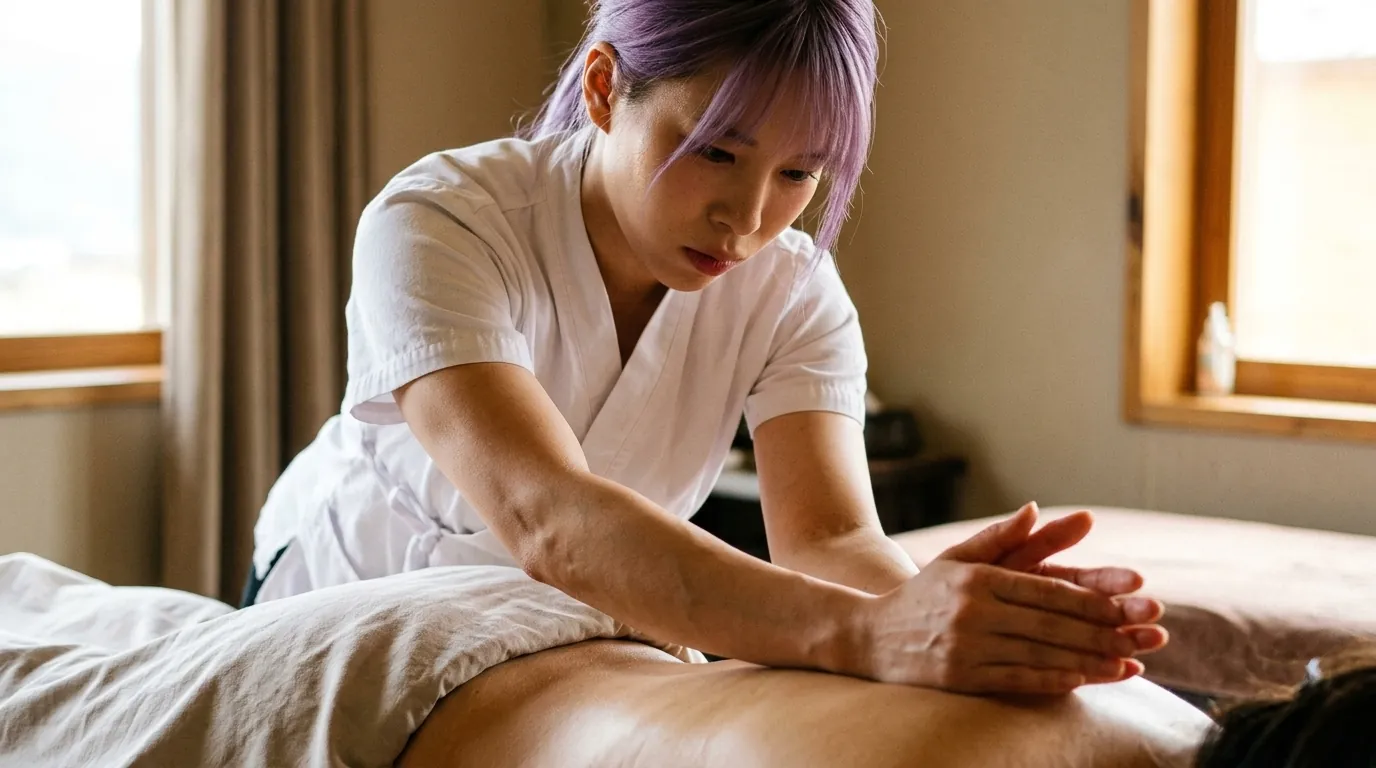
A couple massage is two separate massages running side by side in one room. Each guest has their own table and their own practitioner, and each can choose a different treatment and a different pressure. The two sessions begin and end together, so the hour is shared even though the work on each table is entirely individual.
How is the room set up for two people?
Two tables are set up side by side, a short distance apart and facing the same way. Close enough that you can hear each other breathe. Far enough apart that neither practitioner is working around the other. You are shown in together, you settle at the same time, and one practitioner stays with each of you for the whole session.
The two massages run in parallel rather than in step. Your practitioner is not matching their strokes to the table beside you and is not working to the other guest's preferences. The only coordination that matters is the beginning and the end, which are timed to land together so neither of you is left lying there alone.
That is the whole mechanism. A couple massage is not a different technique or a softer version of anything. It is the same work, arranged differently in the room.
Can the two of you have different massages?
Yes, and most people do once they realise it is allowed. One of you might want a Swedish massage, long and slow and gentle, while the other wants deep tissue work on a shoulder that has been complaining all month. The two sit alongside each other without any difficulty.
Pressure is individual in the same way. You each say what you want at the start, and you each adjust during the session, out loud, without checking with the person on the next table. Asking for firmer pressure is not a comment on what your partner chose. If you are not sure what words to use, the pressure guide gives you the vocabulary before you arrive.
The one place the two tables do meet is the clock. If one of you asks for ten quiet minutes on the neck alone, that time comes out of your own session rather than the room's, so your practitioner will fold it into the plan and still finish when the other table does. Nothing you ask for slows the person beside you down.
Length is the one thing worth agreeing on. Both sessions are normally booked at the same length so that you finish at the same moment. A shorter session and a longer one are both available, so choose between them together rather than separately.
Do you talk to each other during a couple massage?
More at the start than people expect, and far less by the end. The first few minutes tend to be quiet running commentary. Someone says this is nice. Someone laughs at the ceiling. Then the room goes quiet by itself, usually without either of you deciding that it should.
There is no rule. You can talk the whole way through if that suits you both, quietly. The only thing worth doing is agreeing beforehand, because the most common small disappointment in a shared room is one person wanting to chat while the other wants to disappear into the hour. Decide which one you are before you arrive, and say it out loud.
Worth knowing: your practitioners will not join in. They will answer you, then leave the conversation where it was. That is not coldness, it is the job. Their attention stays on the body in front of them.
What do the start and the finish look like?
- Arriving togetherYou are shown into the room as a pair. Coats, bags and phones go down at the same time, and you are left alone for a few minutes to get ready and settle onto the tables.
- Saying what you each wantEach practitioner asks their own guest what they are after: where to focus, what to leave alone, how firm the pressure should be. Answer for yourself. Speaking for both of you is how one of you ends up with the wrong massage.
- Settling inBoth sessions begin at the same moment. This is the stretch where you are still half aware of the other table, still tracking whether they are enjoying it. It passes.
- The middleAt some point you stop noticing the room and the hour becomes yours alone. Most people cannot say afterwards when that happened, only that it did.
- The finishBoth practitioners bring their session to a close within a minute of each other and step out. You get dressed in your own time, in the same room, with nobody hurrying you. You leave as you came in, together and considerably slower.
Who does a shared room suit?
- Two people who want to spend an hour close to each other without having to talk, plan anything or look at a screen.
- Someone nervous about their first massage who would feel steadier with a familiar person in the room.
- Anyone marking an occasion who would rather do something quiet than something loud. The date night piece plans that evening out properly.
- Friends, siblings, a parent and a grown child. The format has nothing to do with romance and everything to do with there being two of you.
When is a shared room the wrong choice?
It is not automatically the better option, and it is worth being honest about that before you book. If one of you wants serious, focused work and knows they will be self-conscious with company in the room, two separate sessions on the same afternoon will serve you both better. Book them close together and meet afterwards.
It is also worth checking what you are actually picturing. If the appeal is two practitioners rather than two guests, that is a different treatment altogether, and the comparison between the two sorts it out in a minute. People book one meaning the other more often than you would think.
And if this really is a first massage for one of you, know that the shared room takes away some of the nerves and adds a couple of new ones. Reading through how a first session goes beforehand removes most of them.
What should you settle before you book?
One more thing, said plainly. If either of you is pregnant, recovering from an injury, or living with a medical condition, speak to your doctor before you book. Your practitioner will ask what to avoid and can adapt how they work, but they are not there to give medical advice and should not be asked for it.
Beyond that there is very little to prepare. Turn up with time to spare, have a rough idea of what you want, and let the next hour be somebody else's responsibility. The treatment menu shows the shared session alongside the individual ones, if you want to see how it sits against them.
Common questions
Are the two of you in the same room, or two rooms next to each other?
The same room. That is the whole point of the format. Two tables are set up in one space, a short distance apart, and both sessions run at the same time. If you would rather be in separate rooms, you are really looking at two individual bookings on the same afternoon.
Can two friends book a couple massage?
Yes. The word couple describes the number of guests, not the relationship between them. Friends book it, siblings book it, and so do a parent and a grown child. Nobody at the spa needs to know which you are.
Do both sessions have to be the same length?
In practice they usually are, because matching lengths is what lets you start and finish together. A shorter and a longer session in one room would leave one of you dressed and waiting. If you want different lengths, ask the spa before you book rather than on the day.
Can you hold hands during a couple massage?
Some people do, when the tables are close enough and both of you are face up. For a good part of the session you will be face down with your arms at your sides, so it is not something to plan the hour around. Treat it as a small thing that may happen rather than a feature.
What happens if one of you wants to stop early?
Say so. Your practitioner will finish up and you can wait comfortably while the other session runs to its end. Nobody expects both guests to want exactly the same amount of massage, and stopping early does not interrupt the other table.